


INTRODUCTION
Walk down any street and ask people what scares them economically.
Most will say inflation. Rising prices. Shrinking paychecks. The feeling that your money buys less every year.
It’s understandable. Inflation touches everyone. You feel it at the grocery store, the gas pump, when rent increases. It’s the “silent tax” that slowly erodes your purchasing power.
But ask economists the same question, and you’ll get a different answer.
They fear deflation more.
Falling prices sound like a blessing. Who wouldn’t want everything to cost less? But beneath that surface lies something darker—an economic trap that’s far harder to escape than inflation.
Let’s break down why both are dangerous, but why one keeps central bankers awake at night.
WHAT IS INFLATION?
Inflation is the gradual increase in prices over time.
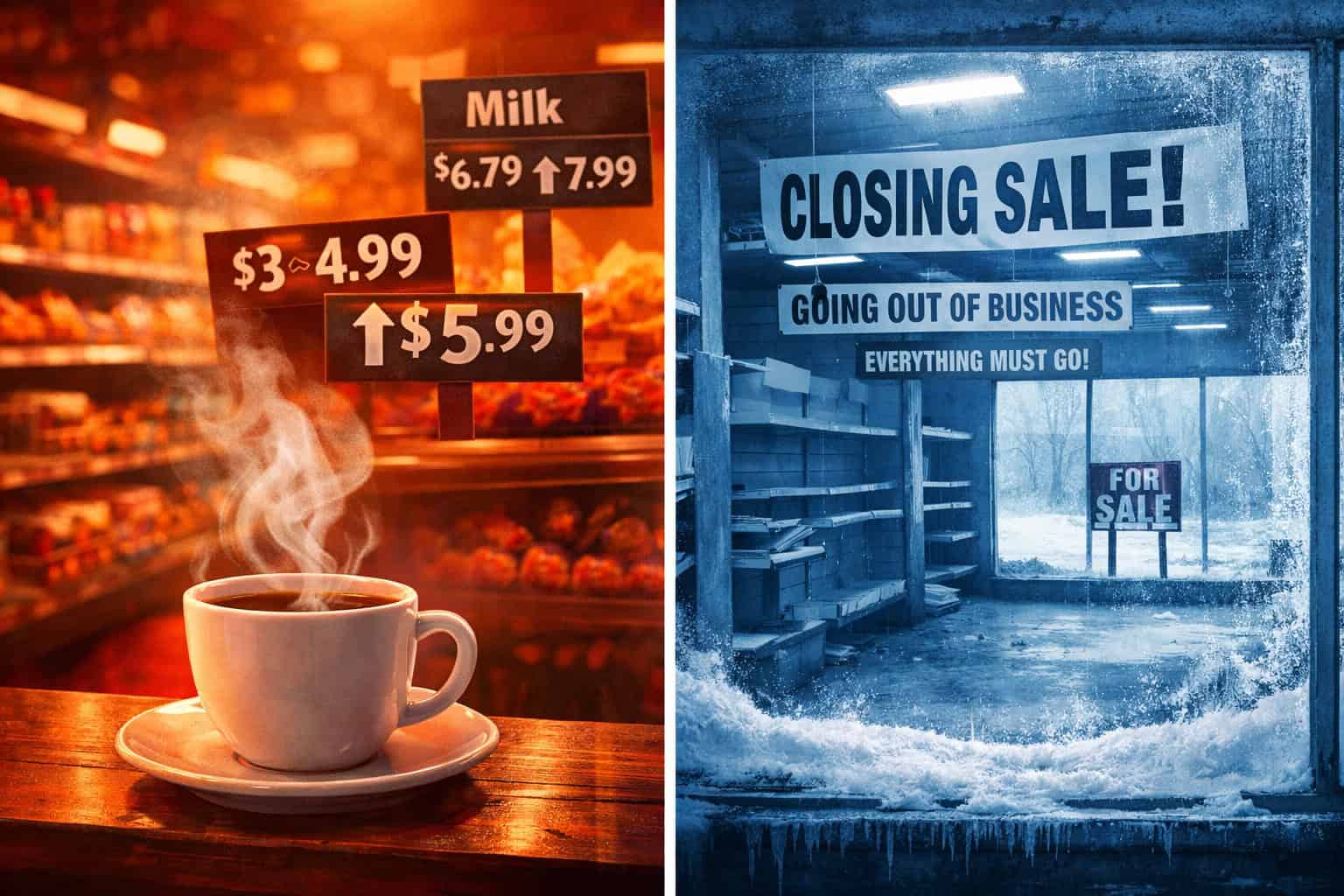
When inflation is running at 2-3% annually, it’s barely noticeable month to month. But over the years, it adds up. A $2 coffee becomes $2.20, then $2.50, then $3. Your dollar buys less.
Inflation happens for many reasons:
- Too much money chasing too few goods
- Rising production costs passed to consumers
- Expectations of future inflation causing wage and price increases
Mild inflation (2-3%) is considered healthy by most central banks. It encourages spending and investing rather than hoarding cash. It makes debt cheaper over time. It gives economies room to grow.
But high inflation (double digits) is destructive. It erodes savings. It creates uncertainty. It punishes anyone on fixed incomes.
WHAT IS DEFLATION?
Deflation is the opposite—prices fall over time.
A $2 coffee becomes $1.80, then $1.50. Sounds wonderful until you realize wages are also falling. Home values are dropping. Business revenues are shrinking. And your debt? That stays exactly the same.
Deflation happens when:
- Demand collapses (people stop buying)
- Excess supply floods markets
- Debt burdens become unsustainable
- Credit freezes
The last major deflationary period was the Great Depression of the 1930s, when prices fell roughly 30% and unemployment hit 25%.
8 KEY DIFFERENCES BETWEEN INFLATION AND DEFLATION
1. CONSUMER PSYCHOLOGY
Inflation: People spend now because tomorrow will cost more. “Buy before prices go up!” This spending fuels economic activity. Money circulates. Businesses thrive.
Deflation: People delay purchases because tomorrow will cost less. “Why buy a car today if it’s 10% cheaper next quarter?” This waiting freezes the economy. Businesses can’t sell. Inventories pile up. Workers get laid off.
2. IMPACT ON DEBT
Inflation: Debt becomes cheaper over time. You borrowed $200,000 for a house. Twenty years later, you’re paying that same amount with dollars worth less. Your real debt burden shrinks.
Deflation: Debt becomes crushing. You borrowed $200,000. Your income drops 20%. Your home value drops 30%. But you still owe $200,000. The real burden grows heavier every day.
3. CENTRAL BANK RESPONSE
Inflation: Central banks raise interest rates. It’s painful but straightforward. Higher rates cool spending and bring prices down. The tool exists and it works.
Deflation: Central banks cut rates to encourage borrowing. But rates can’t go below zero effectively. Once rates hit zero and deflation persists, they’ve fired their best weapon. Japan has struggled with deflationary pressure for decades despite every tool imaginable.
4. IMPACT ON WAGES
Inflation: Wages typically rise with inflation over time (though often lagging). Collective bargaining, minimum wage adjustments, and cost-of-living increases help workers keep pace.
Deflation: Wages fall. Sometimes dramatically. Companies with shrinking revenues can’t maintain payrolls. Layoffs happen. The lucky employed often take pay cuts. Your paycheck shrinks while your mortgage payment stays fixed.
5. ASSET VALUES
Inflation: Real assets (real estate, stocks, commodities) often rise with inflation. They’re hedges against money losing value. Your house price keeps pace with or exceeds inflation over time.
Deflation: Asset values collapse. Homes worth $300,000 become worth $200,000. Stock portfolios drop 30-50%. Retirement savings evaporate. The collateral banks rely on disappears.
6. BUSINESS BEHAVIOR
Inflation: Businesses raise prices. They invest in capacity because future demand looks strong. They hire workers. The economy hums.
Deflation: Businesses cut prices to survive. Margins disappear. Investment stops because the future looks uncertain. Hiring freezes turn into layoffs. The economy contracts.
7. HISTORICAL EXAMPLES
Inflation: Germany 1920s (hyperinflation). US 1970s (stagflation). Painful, yes. But economies recovered with policy changes.
Deflation: Great Depression 1930s. Japan 1990s-2000s (lost decades). These were existential threats that took years or decades to escape. The social and political damage was immense.
8. WHO SUFFERS MOST
Inflation: Hurts savers, retirees on fixed incomes, and cash-heavy households. People with debt actually benefit.
Deflation: Hurts everyone. Debtors can’t pay. Savers see cash “grow” but lose income. Workers lose jobs. Homeowners lose equity. Businesses fail. No one escapes the deflationary trap.
WHY CENTRAL BANKS TARGET 2% INFLATION
This is the key insight:
Central banks don’t target 2% inflation because they want your money to shrink.
They target it because 2% inflation is the insurance policy against deflation.
A small buffer of inflation means interest rates can stay positive. When recessions hit, central banks can cut rates 2-3% to stimulate the economy. They have room to work.
If inflation were zero, rates would already be near zero. No room to cut. No ammunition when crisis hits.
And if deflation appears, rates can’t go low enough to stop it.
REAL NUMBERS EXAMPLE
Inflation Scenario (3% annually):
- $100 in cash today
- Buys $97 worth of goods next year
- Buys $74 worth in 10 years
- But your home value likely rose
- Your wages likely rose
- Your fixed mortgage got cheaper in real terms
Deflation Scenario (3% annually):
- $100 in cash today
- Buys $103 worth of goods next year (yay!)
- But your home value dropped 3%
- Your wages dropped 3-5%
- Your $2,000 mortgage now consumes more of your smaller paycheck
- Your job is less secure because businesses are struggling
The cash saver “wins” on paper. But the broader economic destruction leaves few untouched.
SO WHAT SHOULD YOU DO?
To protect against INFLATION:
- Own productive assets (stocks, real estate, businesses)
- Avoid holding excessive cash
- Use fixed-rate debt strategically
- Invest in assets with pricing power
To protect against DEFLATION:
- Keep emergency savings (cash becomes more valuable)
- Maintain stable income streams
- Avoid variable-rate debt
- Own defensive assets (government bonds, essential goods companies)
The reality: Most economies oscillate between mild inflation and occasional deflationary scares. The best portfolio owns assets that can weather both.
FINAL THOUGHT
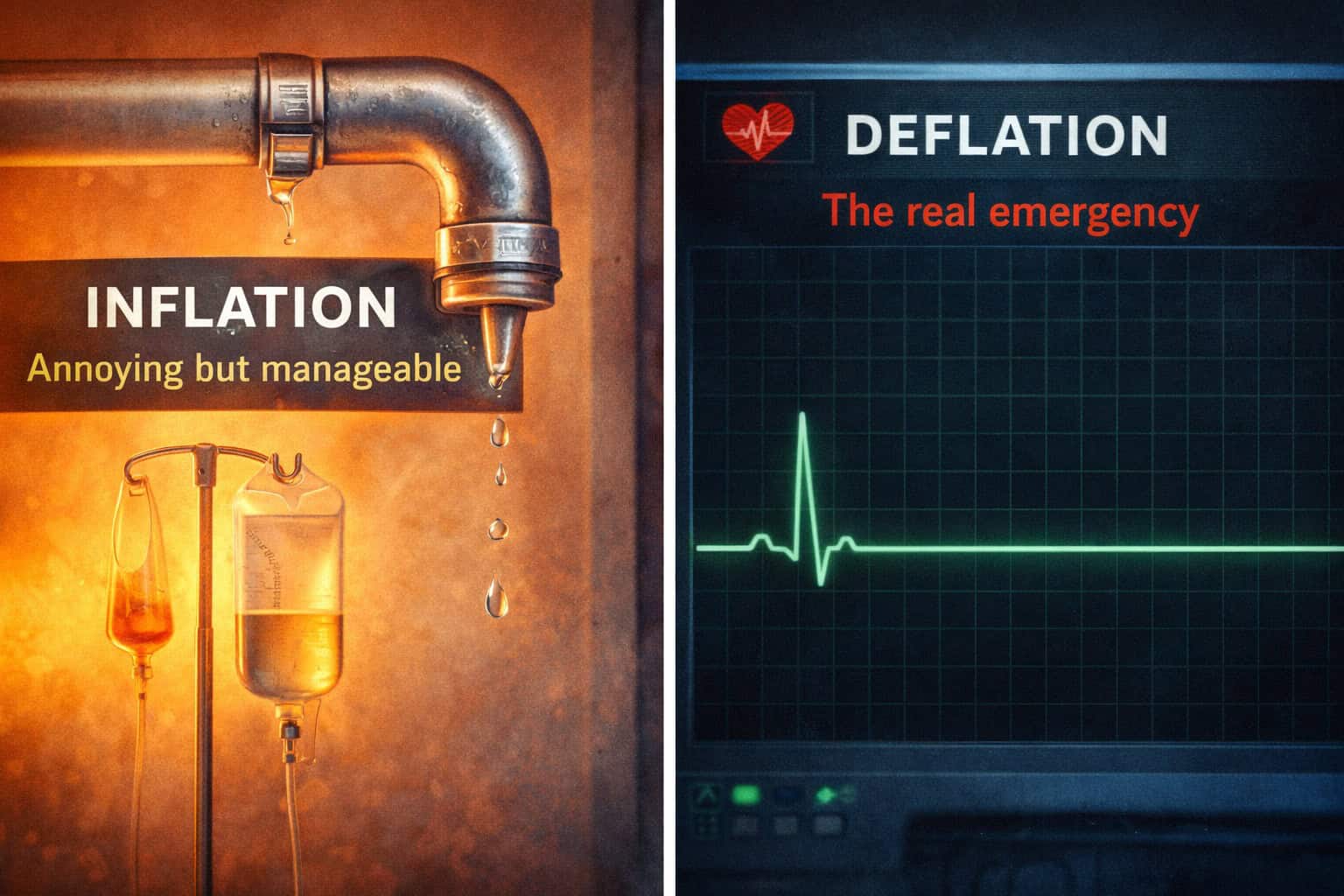
Inflation is the economic equivalent of a slow leak. Annoying. Costly. Gradually draining your resources.
Deflation is the economic equivalent of cardiac arrest. Sudden. Systemic. Potentially fatal.
That’s why your central bank tolerates the leak. They can patch it. They can manage it.
But cardiac arrest? That’s the nightmare they spend every day trying to prevent.
READY TO BUILD A PORTFOLIO FOR BOTH SCENARIOS?
VISIT wealthintelreport.com for our free Economic Survival Guide. We’ll show you exactly how to position your investments whether prices rise OR fall.
FOLLOW @wealthintel on TikTok for daily economic truth bombs that actually build wealth.
Disclaimer: For educational use only — not financial advice or economic forecasting. Past cycles don’t guarantee future results; inflation and deflation affect everyone differently. Consult a qualified professional before making investment decisions. wealthintelreport.com and @wealthIntel are not registered advisors and assume no liability.