

INTRODUCTION
The words get thrown around casually.
“This is a depression.”
“We’re living through another 1930s.”
“Everything is crashing.”
But words mean things. Especially in economics.
A recession and a depression are not the same thing. They’re not even close. They’re different in scale, duration, severity, and human cost.
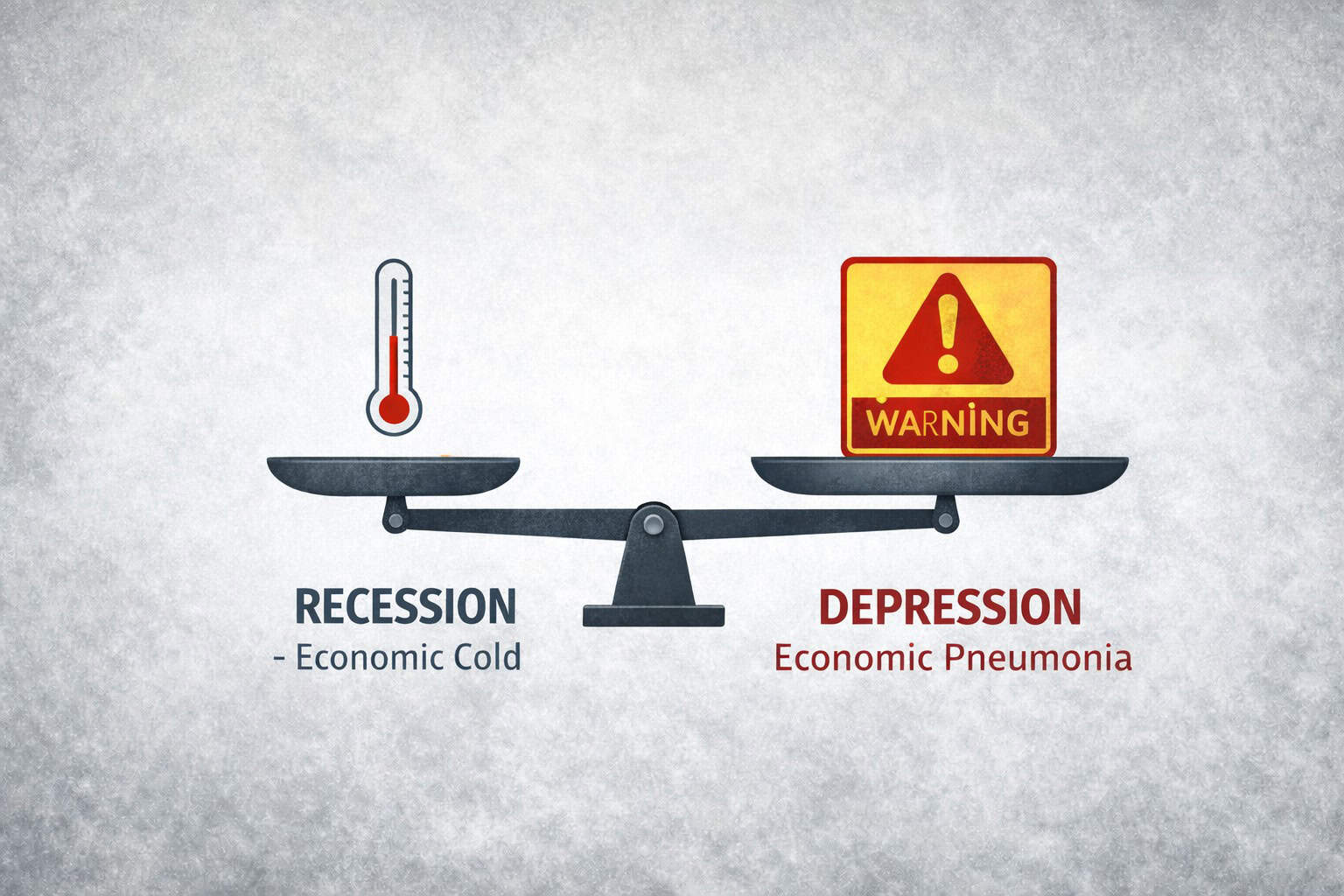
A recession is an economic cold. Unpleasant. Disruptive. However, it can be overcome through rest and proper care.
A depression is economic pneumonia. Your lungs fill. Your body shuts down. Survival is not guaranteed.
Understanding the difference isn’t academic. It shapes how you prepare, how you invest, and how you interpret the world around you.
Let’s break down exactly what separates these two words.
WHAT IS A RECESSION?
A recession is a significant decline in economic activity spread across the economy, lasting more than a few months.
The formal definition varies by country, but common markers include:
- Two consecutive quarters of negative GDP growth
- Rising unemployment
- Falling retail sales
- Declining manufacturing output
Recessions are normal. Since 1854, the US has experienced 33 recessions. They’re part of the economic cycle—the inevitable correction after periods of overexpansion.
The average recession since World War II lasted about 10 months. The worst in recent memory, the 2008 Financial Crisis, lasted 18 months. Unemployment peaked at 10%. GDP fell about 4%.
Bad? Absolutely. Life-altering for millions. But the economy eventually recovered. Jobs returned. Growth resumed.
WHAT IS A DEPRESSION?
A depression is a recession that doesn’t end.
There’s no formal definition like “two quarters of negative growth.” Instead, economists look for:
- GDP contraction exceeding 10%
- Unemployment rates above 20%
- Duration spanning years, not months
- Widespread bank failures and credit collapse
- Deflation (falling prices) that worsens debt burdens
The last depression in modern history was the Great Depression of the 1930s. From 1929 to 1933, US GDP fell by 30%. Industrial production dropped by half. Unemployment hit 25%. Over 9,000 banks failed.
Recovery took over a decade. And it only fully arrived because of World War II’s massive government spending.
No developed economy has experienced a true depression since. The 2008 crisis, as severe as it was, doesn’t come close.
8 KEY DIFFERENCES BETWEEN RECESSION AND DEPRESSION
1. DURATION
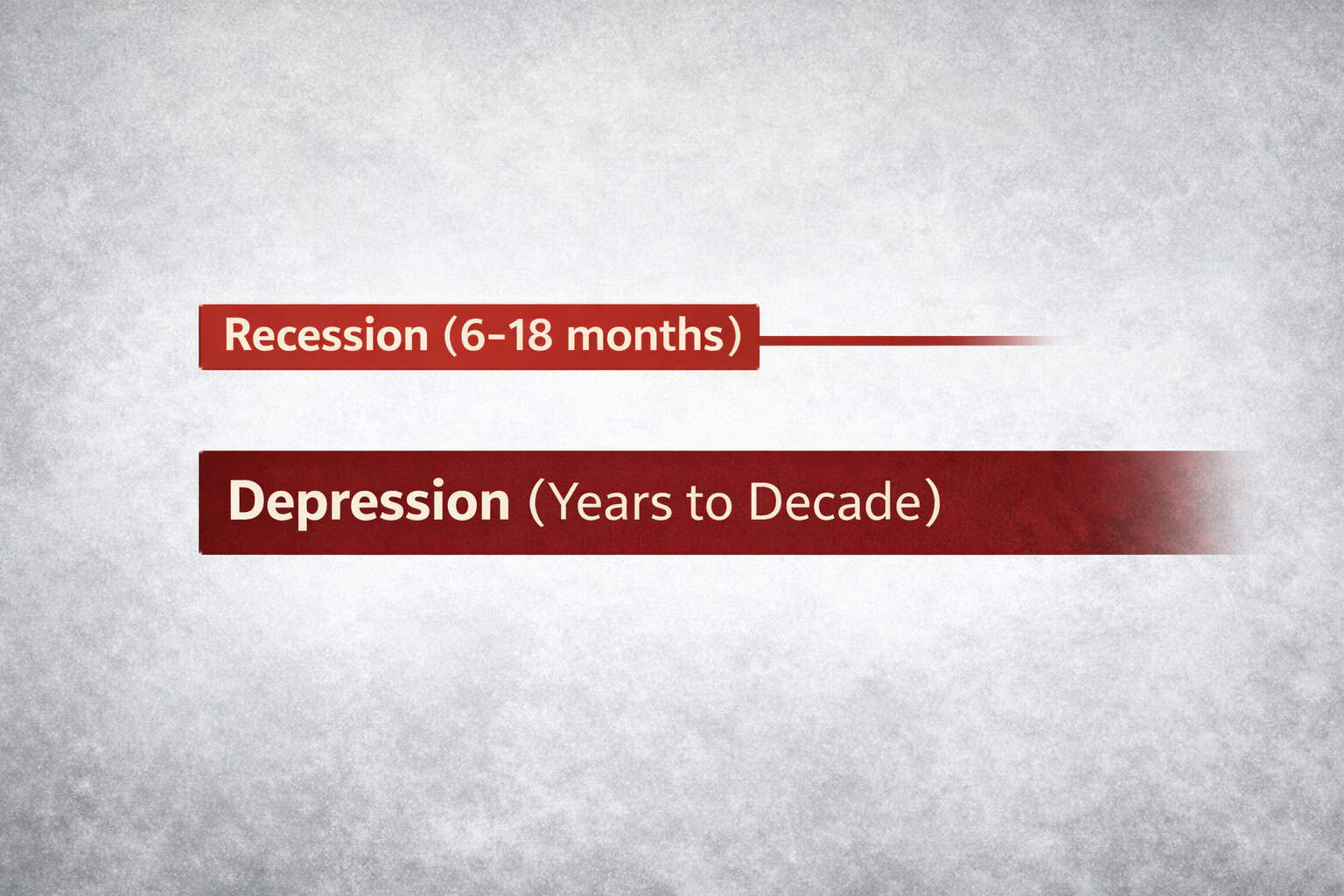
Recession: Months. Typically 6-18 months. The 2008 recession lasted 18 months. The COVID recession lasted just 2 months (officially). They have beginnings, middles, and ends.
Depression: Years. The Great Depression lasted from 1929 until 1941—12 years. An entire childhood was lived through economic collapse. Generations scarred.
2. UNEMPLOYMENT
Recession: Unemployment rises but typically stays below 10%. The 2008 peak was 10%. The COVID peak hit 14.8% briefly but recovered quickly.
Depression: Unemployment exceeds 20%—often much higher. At the Great Depression’s worst, 25% of Americans were unemployed. In some cities, it hit 50%. One in four workers had no income. No safety net. No unemployment insurance widely available then.
3. GDP CONTRACTION
Recession: GDP declines 2-5%. Painful but manageable. The economy shrinks, then stabilizes, then grows again.
Depression: GDP can fall 30% or more. The Great Depression saw GDP drop 30% from 1929 to 1933. Industrial production fell 47%. The economy didn’t just shrink—it collapsed.
4. BANKING SYSTEM IMPACT
Recession: Some banks fail. The weakest institutions with bad loans go under. But the system survives. FDIC insurance protects depositors (in the US since 1933).
Depression: Banking systems collapse. In the 1930s, over 9,000 banks failed. No FDIC existed yet. Families walked to banks that held their life savings and found locked doors and empty vaults. Trust in the entire financial system evaporated.
5. DEFLATION
Recession: Inflation often slows, but deflation (falling prices) is rare and usually mild when it appears.
Depression: Deflation becomes severe and self-reinforcing. Prices fell 30% in the Great Depression. Sounds good until you realize wages fell faster, debt stayed fixed, and businesses couldn’t sell inventory at any price.
6. RECOVERY MECHANISMS
Recession: Normal policy tools work. Central banks cut interest rates. Governments stimulate spending. The economy responds. It might take years, but recovery happens.
Depression: Normal tools fail. Interest rates hit zero and can’t go lower. Stimulus feels like spitting into a hurricane. Japan’s “Lost Decade” showed how deflationary traps resist every known remedy.
7. SOCIAL AND POLITICAL IMPACT
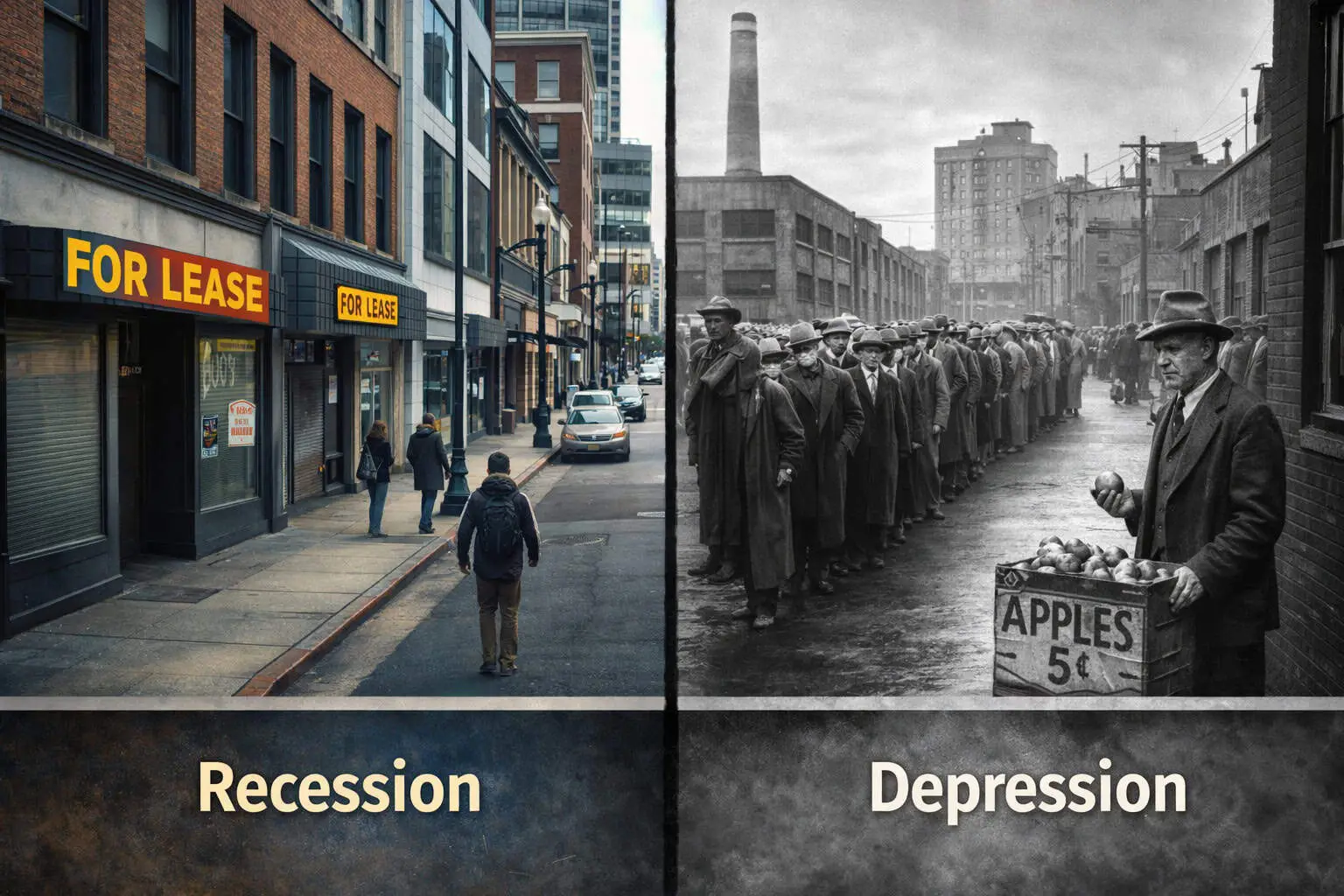
Recession: People struggle. Dreams are delayed. Retirement accounts shrink. But society holds together.
Depression: Social fabric tears. Bread lines stretch blocks. Hoovervilles (shantytowns) appear in major cities. Suicide rates spike. Political extremism rises. Democracies fall to fascists and communists. The Great Depression directly enabled Hitler’s rise in Germany.
8. FREQUENCY
Recession: Common. The US has experienced 33 recessions since 1854. They’re normal economic weather.
Depression: Rare. One in the last 150 years for developed economies. A statistical anomaly. A once-in-multiple-lifetimes event.
WHY WE HAVEN’T HAD ANOTHER DEPRESSION
This matters:
The Great Depression created systems specifically designed to prevent another one.
- FDIC insurance so bank failures don’t wipe out families
- Social Security so the elderly have income floors
- Unemployment insurance so jobless workers can still eat
- Active central banking (the Fed) that cuts rates aggressively
- Automatic stabilizers like food stamps that kick in during downturns
These weren’t accidents. They were built in response to the 1930s nightmare.
That’s why 2008, as bad as it was, never became 1929. The firebreaks held.
REAL NUMBERS COMPARISON
| Metric | Typical Recession | Great Depression |
|---|---|---|
| Duration | 6-18 months | 12 years |
| GDP Drop | 2-5% | 30% |
| Unemployment Peak | 8-10% | 25%+ |
| Bank Failures | Dozens | 9,000+ |
| Stock Market Drop | 30-50% | 89% |
| Recovery Time | 2-4 years | 12+ years |
SO WHAT SHOULD YOU DO?
In a Recession:
- Stay invested (markets recover before economies do)
- Keep emergency savings (3-6 months expenses)
- Consider opportunities (assets get cheaper)
- Maintain income streams
In a Depression (theoretical):
- Preserve cash (deflation makes it more valuable)
- Eliminate all debt (fixed payments become crushing)
- Diversify income sources
- Hold tangible assets (food, supplies, skills)
- Prepare for systemic breakdown
But here’s the comfort: You will almost certainly never face a true depression in your lifetime. The safeguards are too strong. The policymakers are too aware. The memory is too fresh.
Recessions? You’ll face several. Prepare for those.
FINAL THOUGHT
Words matter.
Calling every economic downturn a “depression” diminishes what that word actually means. It trivializes the suffering of those who lived through the 1930s. And it blinds you to the appropriate response.
A recession is serious. Treat it seriously.
But a depression is something else entirely. Respect the difference.
READY TO BUILD A RECESSION-PROOF PORTFOLIO?
VISIT wealthintelreport.com for our free Economic Survival Guide. We’ll show you exactly how to position your investments for any economic weather—recession, recovery, or anything in between.
FOLLOW @wealth Intel on TikTok for daily economic truth bombs that actually build wealth.
DISCLAIMER: Content is for educational purposes only, not financial advice. Economic cycles are complex, with varied causes; past performance does not guarantee future results. Individual circumstances differ; consult a qualified professional before investing. WealthIntelReport.com and @WealthIntel assume no liability for decisions made based on this information.