


INTRODUCTION
Walk into any investing conversation and you’ll hear two very different arguments.
One side talks about the future. AI. Cloud computing. Electric vehicles. The next Apple or Amazon is hiding in plain sight. They’re chasing the stock that could 10X in five years.
The other side talks about income. Dividends. Reliability. Companies that have paid shareholders for decades without interruption. They’re collecting checks while the world spins.
Both sides are right.
Tech stocks and utility stocks sit at opposite ends of the investing spectrum. One offers explosive growth with heart-stopping volatility. The other offers boring stability with reliable income.
But here’s the secret the pros know: You don’t have to choose.
Let’s break down exactly how both work and why the smartest portfolios own a piece of each.
WHAT ARE TECH STOCKS?
Tech stocks represent companies in the technology sector.
Think software (Microsoft, Adobe), hardware (Apple, Dell), semiconductors (Nvidia, Intel), cloud computing (Amazon Web Services, Google Cloud), artificial intelligence, and emerging digital industries.
These companies thrive on innovation. They reinvest profits into research, development, and expansion rather than paying dividends. Their goal is growth—massive, exponential growth.
Tech stocks are volatile. A great tech company can drop 40% in a bad quarter and double in the next two years. They require strong nerves and long time horizons.
But the upside? Life-changing. A $10,000 investment in Amazon in 2000 would be worth over $1 million today.
WHAT ARE UTILITY STOCKS?
Utility stocks represent companies providing essential services.
Electricity (NextEra Energy, Duke Energy). Natural gas (Southern Company, Dominion Energy). Water (American Water Works). These are the pipes and wires that keep modern life running.
These companies operate as regulated monopolies. Governments grant them exclusive territories in exchange for price controls. Competition is limited. Profits are predictable.
Utility stocks pay dividends, often substantial ones. They grow slowly (typically 2-6% annually) but steadily. They’re defensive, meaning they hold up better during economic downturns.
A $10,000 investment in utilities won’t make you a millionaire. But it will pay you reliable income decade after decade while you sleep soundly.
8 KEY DIFFERENCES BETWEEN TECH AND UTILITY STOCKS
1. GROWTH POTENTIAL
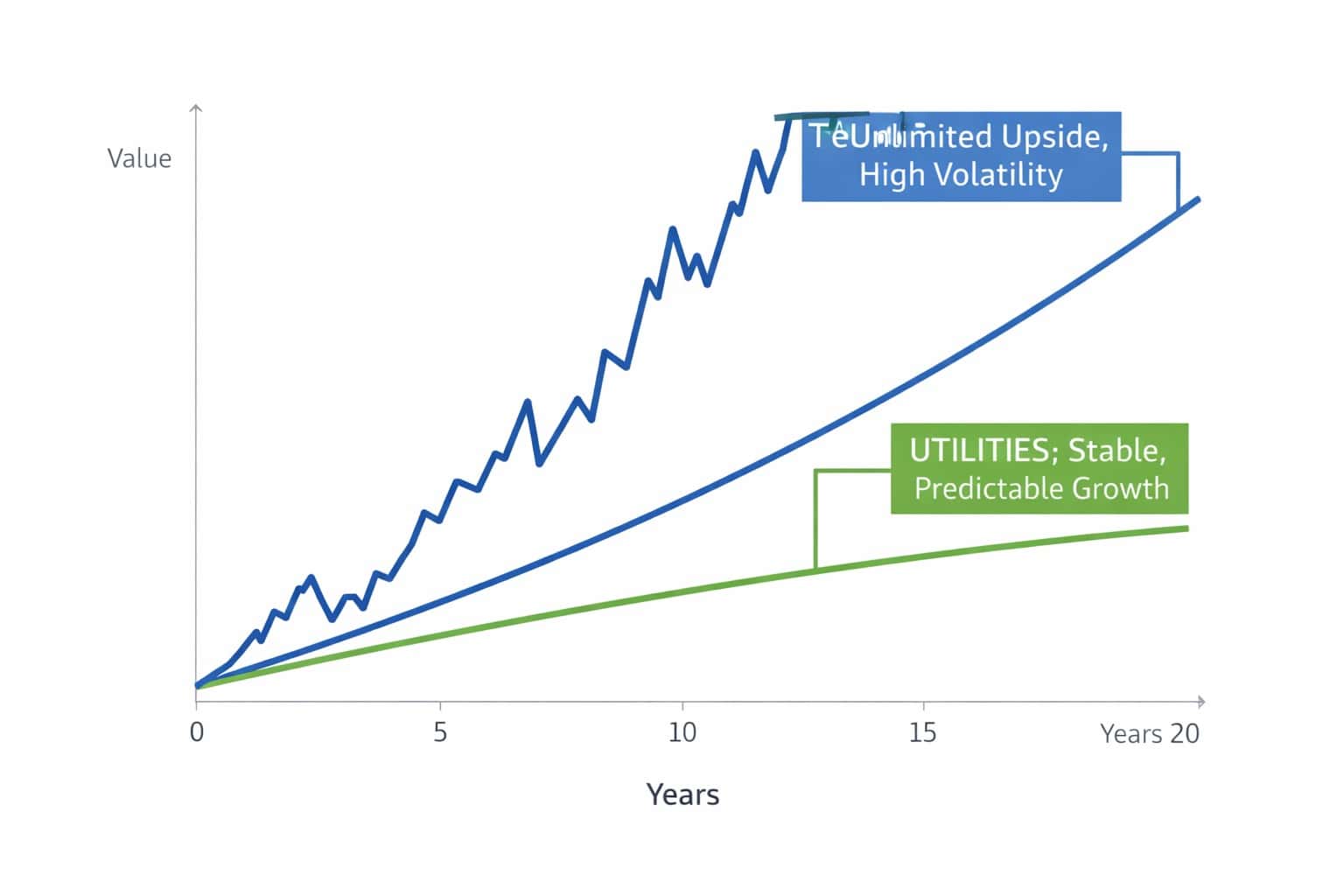
Tech Stocks: Unlimited upside. A breakthrough product can transform a small company into a giant. The total addressable market for new technologies is often global and massive. Winners compound at extraordinary rates.
Utility Stocks: Limited growth. Revenue is tied to population and usage, not innovation. Governments cap profit margins. A utility growing 5% annually is considered strong. There are no 10X utility stocks.
2. INCOME (DIVIDENDS)
Tech Stocks: Most tech companies pay little to no dividends. They reinvest every dollar into growth. Some mature tech giants (Apple, Microsoft) now pay modest dividends, but the yield is typically below 1%.
Utility Stocks: Dividends are the entire point. Yields often range from 3-5%. Many utilities have increased dividends annually for 25+ consecutive years. They’re Dividend Aristocrats for a reason.
3. VOLATILITY
Tech Stocks: Extreme. Tech is the most volatile major sector. A 20-30% drop is routine. 50% drops happen in bear markets. If you can’t handle watching your portfolio fluctuate, tech will give you ulcers.
Utility Stocks: Minimal. Utilities move like a slow boat. They drop less in crashes and rise less in booms. Beta (volatility measure) is often below 0.5, meaning they’re half as volatile as the overall market.
4. ECONOMIC SENSITIVITY
Tech Stocks: Highly sensitive to economic cycles. In booms, companies spend heavily on new technology. In a bust, tech budgets get cut first. Tech stocks thrive in growth economies and suffer in recessions.
Utility Stocks: Defensive. People need electricity and water regardless of the economy. Utility revenues are stable through boom and bust. During the 2008 financial crisis, utilities actually gained while the market crashed.
5. INNOVATION RISK
Tech Stocks: Constant disruption. Today’s dominant tech company could be obsolete in a decade. Remember BlackBerry? MySpace? Yahoo? Tech winners must keep winning, or they’re replaced.
Utility Stocks: Disruption risk is minimal. Governments aren’t letting new competitors build duplicate power grids. The infrastructure is too expensive and unnecessary. Utilities have natural monopolies.
6. REGULATORY ENVIRONMENT
Tech Stocks: Increasing scrutiny. Antitrust concerns. Privacy regulations. International restrictions. Tech companies face growing regulatory pressure worldwide that could limit future growth.
Utility Stocks: Regulation IS their business model. They operate within clear frameworks. Rate cases determine allowed profits. The relationship with regulators is stable and predictable.
7. VALUATION METRICS
Tech Stocks: Priced for growth. High P/E ratios (sometimes 30-100X earnings) are common. Investors pay for future potential, not current profits. When growth slows, valuations collapse.
Utility Stocks: Priced for income. Lower P/E ratios (typically 15-20X earnings). Valued based on dividend yield and stability. Investors care more about dividend safety than growth stories.
8. IDEAL INVESTOR PROFILE
Tech Stocks: Young investors with long time horizons. People who can handle volatility and won’t panic sell. Those seeking maximum long-term growth.
Utility Stocks: Retirees and income-focused investors. People who need reliable cash flow. Those nearing or in retirement who prioritize sleep-at-night stability.
THE IDEAL STRATEGY: AGE-BASED ALLOCATION
Here’s how to think about splitting between tech and utilities:
Age 20-40: 80% Tech / 20% Utilities
You have decades to ride the volatility. Tech’s growth potential outweighs the risk. Keep a small utility allocation as a diversifier and reminder that boring works.
Age 40-55: 60% Tech / 40% Utilities
Start shifting toward balance. Your time horizon shortens. The compounding from utilities becomes more valuable as you approach income needs.
Age 55-65: 40% Tech / 60% Utilities
Protection mode. You can’t afford a 50% tech crash right before retirement. Utilities provide income and stability. Tech provides some continued growth.
Age 65+: 20% Tech / 80% Utilities
Income focus. You need reliable dividends to fund retirement. A small tech allocation keeps some growth potential for the long haul (20+ year retirement).
REAL NUMBERS EXAMPLE
Meet two investors, both starting with $100,000 at age 30:
Alex (All Tech):
- 100% in tech stocks
- Experiences massive volatility
- Average annual return: 12%
- Value at 65: $5.2 million
- But had to survive multiple 40% crashes without selling
Maria (Balanced):
- 60% tech / 40% utilities
- Smoother ride, less stress
- Average annual return: 10%
- Value at 65: $2.8 million
- Plus growing dividend income along the way
- Slept well through every crash
Maria has less money but also less anxiety and a reliable income. Alex has more money but needs iron nerves.
Neither is wrong. They just made different choices based on their psychology.
FINAL THOUGHT
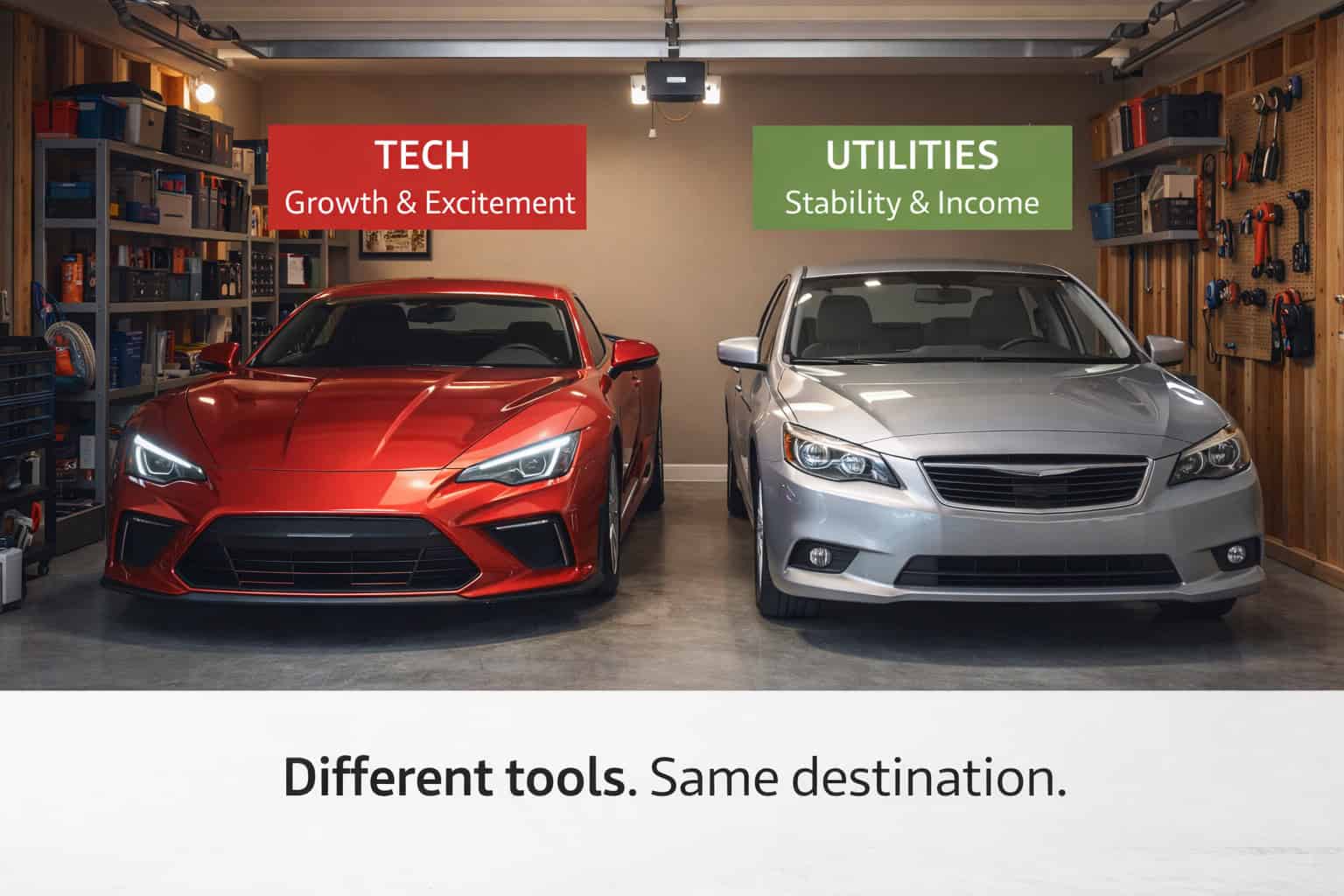
Tech stocks are the sports cars. Fast. Exciting. Occasionally terrifying.
Utility stocks are the reliable sedans. Boring. Comfortable. Gets you there every time.
You don’t have to drive only one. The wisest investors own a garage with both.
Use tech for growth. Use utilities for stability and income. Let them work together.
READY TO BUILD YOUR TECH + UTILITIES PORTFOLIO?
VISIT wealthintelreport.com for our free Age-Based Allocation Guide. We’ll show you exactly how to split your portfolio between growth and stability at every stage of life.
FOLLOW @wealth Intel on TikTok for daily investing truth bombs that actually build wealth.
ISCLAIMER: For educational purposes only, not financial advice. Tech stocks involve high volatility and risk of loss. Utility stocks face regulatory and interest rate risks. Past performance doesn’t guarantee future results. Consult a professional before investing. wealthintelreport.com and @wealth Intel assume no liability.
https://shorturl.fm/ZAyql