


INTRODUCTION
Walk through any shopping mall and you’ll pass both types of companies without thinking twice.
On one end, the restaurant where you celebrate special occasions. The electronics store has the latest iPhone. The car dealership has shiny new vehicles.
On the other end, the grocery store where you buy milk and bread. The pharmacy serves as a place to purchase toothpaste. The gas station is where you fill up your tank.
These aren’t just different shopping experiences. They’re fundamentally different types of businesses that behave completely differently in your portfolio.
Understanding the difference between Consumer Discretionary and Consumer Staples is essential for building a portfolio that can weather economic storms while still capturing growth.
Let’s break down exactly what each sector represents and how to use both.
WHAT IS CONSUMER DISCRETIONARY?
Consumer Discretionary includes companies that sell non-essential goods and services. Things people WANT but don’t technically NEED.
When the economy is strong and people feel confident, these sectors boom. When recession hits, these are the first expenses consumers cut.
Examples include:
- Restaurants: McDonald’s, Starbucks, Chipotle
- Retail: Amazon, Nike, Lululemon, Home Depot
- Automotive: Tesla, Ford, General Motors
- Entertainment: Disney, Netflix, Live Nation
- Hotels & Travel: Marriott, Hilton, Expedia
- Luxury Goods: Louis Vuitton, Tiffany & Co.
These companies thrive on consumer confidence, disposable income, and willingness to spend. Their earnings are cyclical—they rise and fall with the economy.
WHAT IS CONSUMER STAPLES?
Consumer Staples includes companies that sell essential products. Things people NEED regardless of economic conditions.
Whether you’re employed or not, whether the market is up or down, you still need to eat, clean, and maintain basic hygiene.
Examples include:
- Food & Beverage: Coca-Cola, Pepsi, Kraft Heinz, General Mills
- Household Products: Procter & Gamble (Tide, Bounty), Clorox
- Personal Care: Colgate-Palmolive, Kimberly-Clark (Huggies, Cottonelle)
- Tobacco: Altria, Philip Morris
- Groceries: Walmart, Kroger, Costco
These companies are defensive. Their revenues are stable regardless of the economy. They may grow slowly, but they rarely crash.
8 KEY DIFFERENCES BETWEEN DISCRETIONARY AND STAPLES
1. ECONOMIC SENSITIVITY
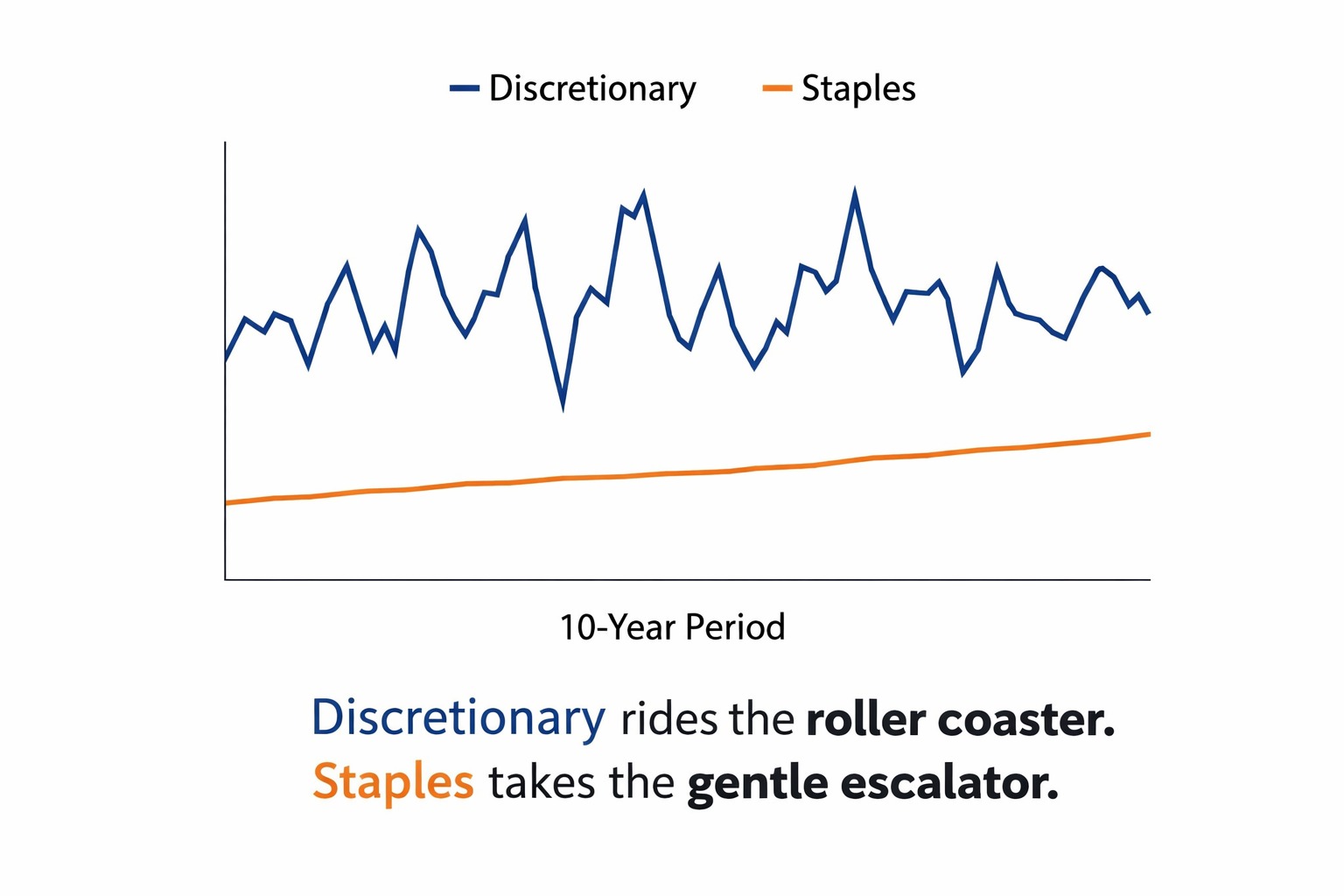
Discretionary: Highly sensitive to economic cycles. When GDP grows, these stocks soar. When recession hits, they plummet. Earnings can swing 20-30% or more based on consumer confidence.
Staples: Nearly immune to economic cycles. People buy roughly the same amount of toilet paper and toothpaste whether the economy is booming or busting. Earnings are predictable and stable.
2. CONSUMER PSYCHOLOGY
Discretionary: Driven by how people FEEL. Consumer confidence indexes directly predict discretionary spending. When people feel optimistic about their jobs and the future, they spend on wants. When fear creeps in, they stop.
Staples: Driven by necessity, not feeling. You don’t check your bank balance before deciding whether to buy toothpaste. You just buy it when you run out. Emotional state barely matters.
3. DIVIDEND BEHAVIOR
Discretionary: Dividends are less consistent. Companies often reinvest earnings into growth rather than paying shareholders. When earnings drop in recessions, dividends can get cut.
Staples: Known for reliable, growing dividends. Procter & Gamble has increased its dividend for 65+ consecutive years. Coca-Cola for 60+ years. These are Dividend Kings because their cash flow is so predictable.
4. VALUATION PATTERNS
Discretionary: P/E ratios expand and contract wildly with economic expectations. During booms, investors pay premium prices for growth. During busts, valuations collapse even if the company is fundamentally sound.
Staples: Trade at relatively stable valuations. Investors pay a premium for safety and predictability, but that premium doesn’t swing wildly with economic news.
5. GROWTH POTENTIAL
Discretionary: Home to explosive growers. Amazon started here. Starbucks. Domino’s. When a discretionary company captures consumer imagination, growth can be extraordinary for years or decades.
Staples: Growth is steady but slow. 3-5% annual revenue growth is typical. These are mature companies in mature industries. You don’t buy staples for home runs—you buy them for base hits and defensive protection.
6. RECESSION PERFORMANCE
Discretionary: Typically drops 30-50% in severe recessions. The 2008 financial crisis saw discretionary stocks fall 40%+ on average. They’re the first to be sold when panic hits.
Staples: Often flat or slightly down in recessions. During 2008, Staples fell roughly 15% while the broader market dropped nearly 40%. They act as a cushion when everything else burns.
7. INTEREST RATE SENSITIVITY
Discretionary: More sensitive to interest rates. Many discretionary purchases (cars, homes, renovations) are financed. Higher rates directly reduce demand.
Staples: Minimal interest rate sensitivity. You don’t finance your grocery bill. Rate changes barely affect demand for necessities.
8. PORTFOLIO ROLE
Discretionary: Growth engine. Offense. The part of your portfolio that captures upside when the economy hums.
Staples: Stability anchor. Defense. The part that protects your capital when recession hits and pays you dividends while you wait.
THE BARBELL STRATEGY
Many sophisticated investors use a “barbell” approach:
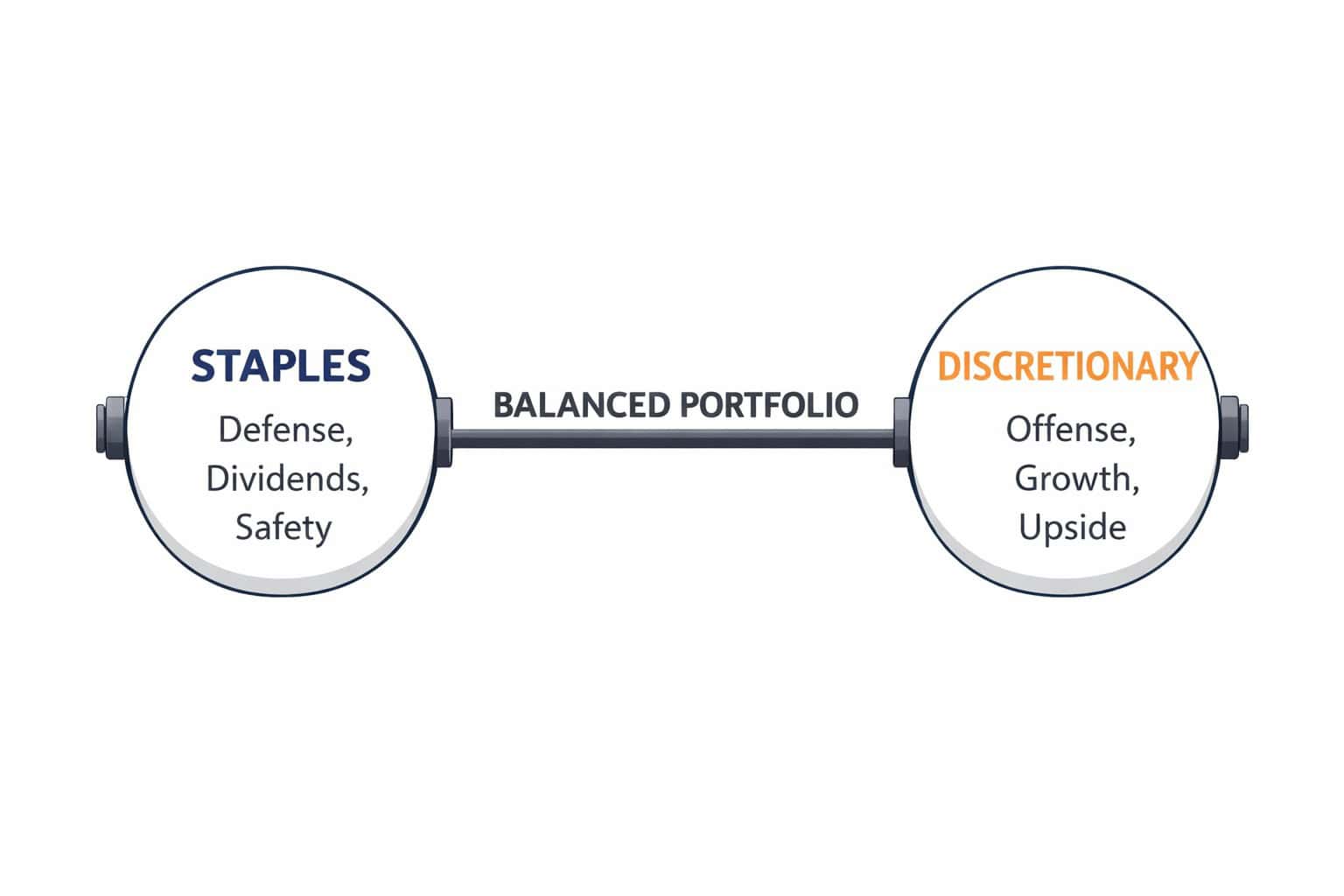
One end of the barbell: Consumer Staples for safety, dividends, and recession protection.
The other end: Consumer Discretionary for growth, innovation, and economic upside.
The middle: Less important. Let the extremes do the work.
The exact allocation depends on:
- Your age: Younger investors tilt toward discretionary for growth. Near-retirees tilt toward staples for protection.
- Economic outlook: If you expect a recession, overweight staples. If you expect a boom, overweight discretionary.
- Risk tolerance: Conservative investors stay heavy in staples. Aggressive investors chase discretionary growth.
REAL NUMBERS EXAMPLE
Let’s compare two $10,000 investments over different periods:
2007-2009 (Financial Crisis):
- S&P 500: -37%
- Consumer Discretionary: -42%
- Consumer Staples: -15%
The staples investor lost less than half what the discretionary investor lost.
2009-2021 (Bull Market):
- S&P 500: +400%
- Consumer Discretionary: +600%
- Consumer Staples: +250%
The discretionary investor more than doubled the staples investor’s returns.
The lesson: Neither is “better.” They’re tools for different times.
HOW TO INVEST IN EACH SECTOR
Individual Stocks:
- Discretionary: Look for companies with strong brands, loyal customers, and room to grow
- Staples: Look for dividend history, market share, and pricing power
ETFs (Easiest for Most Investors):
- Discretionary: XLY (Consumer Discretionary Select Sector SPDR Fund)
- Staples: XLP (Consumer Staples Select Sector SPDR Fund)
- Both: VDC (Vanguard Consumer Staples ETF), VCR (Vanguard Consumer Discretionary ETF)
Target Allocation:
- Age 20-40: 60% discretionary / 40% staples
- Age 40-60: 50% / 50%
- Age 60+: 30% discretionary / 70% staples
FINAL THOUGHT
Consumer Discretionary and Consumer Staples aren’t competing investments.
They’re complementary tools.
Discretionary stocks are your offense. They score big when the economy is strong. They’ll have losing seasons too.
Staples are your defense. They protect your capital when the market turns against you. They pay you dividends while you wait for the next rally.
A smart portfolio needs both.
READY TO BUILD YOUR SECTOR-BALANCED PORTFOLIO?
VISIT wealthintelreport.com for our free Sector Allocation Guide. We’ll show you exactly how to weight consumer sectors based on your age, risk tolerance, and financial goals.
FOLLOW @wealth Intel on TikTok for daily sector investing truth bombs.
DISCLAIMER: For educational purposes only, not financial advice. Consumer sectors carry risks, including economic cycles and competitive pressures. Past performance doesn’t guarantee future results. Always research and consult a professional. wealthintelreport.com and @wealth Intel assume no liability.”