


INTRODUCTION
There’s a reason annuities are a multi-billion dollar industry.
They promise something that feels increasingly rare in modern life: certainty.
A guaranteed paycheck. Every month. For as long as you live. No market watching. No anxiety. No wonder if you’ll outlive your money.
It’s seductive. Especially as retirement approaches and your tolerance for risk naturally declines.
But here’s what annuity salespeople don’t emphasize in their presentations:
That guarantee comes at a cost. A significant one.
Dividend stocks offer a different path. Less certainty on the surface. More volatility. But also more growth, more inflation protection, and ultimately more wealth transferred to your heirs or favorite causes.
Let’s break down exactly how these two income strategies compare so you can decide which one (or which combination) actually fits your life.
WHAT IS AN ANNUITY?
An annuity is a contract between you and an insurance company.
You make a payment either as a lump sum or as a series of payments. In exchange, the insurance company promises to make periodic payments to you, beginning either immediately or at some future date.
There are many flavors:
- Fixed annuities pay a guaranteed interest rate, like a CD with an insurance wrapper
- Variable annuities let you invest in sub-accounts (similar to mutual funds) with potential for growth but also risk
- Indexed annuities tie returns to a market index like the S&P 500, but with caps and floors that limit both upside and downside
- Immediate annuities start paying right away
- Deferred annuities grow tax-deferred before you start withdrawals
The common thread: an insurance company takes your risk in exchange for your money.
WHAT IS A DIVIDEND STOCK PORTFOLIO?
A dividend stock portfolio is simply a collection of publicly traded companies that share their profits with shareholders through regular cash payments.
You own actual shares of businesses like:
- Consumer staples (Procter & Gamble, Coca-Cola, Pepsi)
- Healthcare (Johnson & Johnson, AbbVie, Pfizer)
- Industrials (3M, Caterpillar, Honeywell)
- Utilities (Duke Energy, Southern Company, NextEra)
These companies tend to be mature, profitable, and committed to returning cash to shareholders. Many have increased their dividends annually for decades they’re called Dividend Aristocrats (25+ years of increases) or Dividend Kings (50+ years).
You receive cash quarterly. But you also own the stock itself, which can appreciate over time. And you can sell anytime, leave shares to heirs, or adjust your portfolio as life changes.
8 KEY DIFFERENCES BETWEEN ANNUITIES AND DIVIDEND PORTFOLIOS
1. CERTAINTY VS. UPSIDE
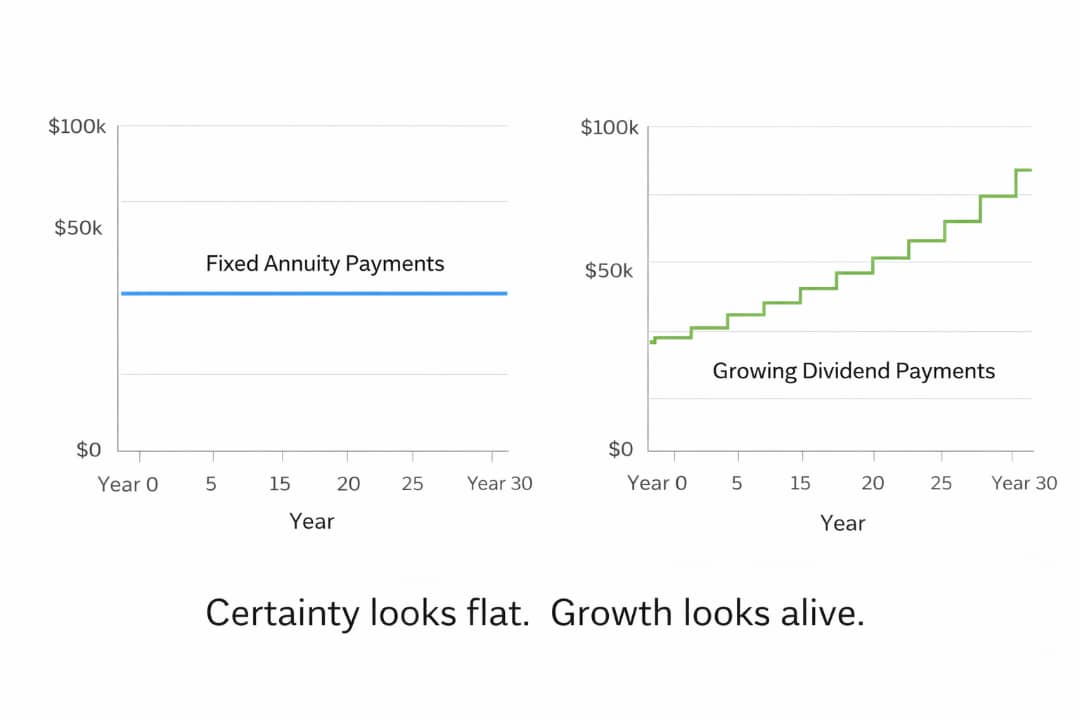
Annuity: The payment is guaranteed. You know exactly what you’ll receive each month. That certainty has real psychological value, especially for retirees who remember 2008 and don’t want to relive it.
Dividend Portfolio: Payments can fluctuate. Companies can cut dividends during hard times (though Dividend Aristocrats rarely do). But your upside is unlimited. Stock prices can double or triple. Dividends can grow. Your income can actually increase over time.
2. INFLATION PROTECTION
Annuity: Fixed annuities offer zero inflation protection. Your $3,000 monthly payment today will buy significantly less in 20 years. Inflation-adjusted annuities exist but pay much less initially, sometimes 30-40% less, because the insurance company is pricing in that future inflation risk.
Dividend Portfolio: Companies raise prices with inflation. They pass those increases to shareholders through growing dividends. Over the past 50 years, dividend growth has generally kept pace with or exceeded inflation. Your income maintains its purchasing power.
3. COSTS AND FEES
Annuity: Complex fee structures that are notoriously difficult to compare. Commissions (often 5-10% of your principal upfront). Mortality and expense charges. Administrative fees. Rider fees for additional features. Variable annuity sub-account expenses. Total costs can easily reach 2-4% annually, embedded in the product where you don’t see a monthly bill.
Dividend Portfolio: If you buy individual stocks through a low-cost broker, your ongoing costs can approach zero. If you use dividend ETFs, expense ratios are typically 0.06% to 0.30%. The difference of 3% annually on a $500,000 portfolio is $15,000 per year—every year—staying in your pocket instead of the insurance company’s.
4. LIQUIDITY AND ACCESS
Annuity: Surrender periods typically last 5-10 years. Withdraw money during this time and you’ll pay penalties often steep ones. Even after surrender periods end, withdrawing a large lump sum can trigger fees or tax consequences. Your money is essentially locked up.
Dividend Portfolio: You can sell anytime. Need $50,000 for a medical emergency? Three business days, and it’s in your bank account. Want to buy an RV? Sell some shares. Your money remains YOUR money.
5. TAX TREATMENT
Annuity: Growth is tax-deferred until withdrawal. That’s the good news. The bad news: withdrawals are taxed as ordinary income, not capital gains. And if you die with money still in the annuity, your heirs pay ordinary income tax on the gains often the highest rate.
Dividend Portfolio: Qualified dividends are taxed at capital gains rates (0%, 15%, or 20%), which are typically lower than ordinary income rates. If you hold stocks until death, your heirs get a “step-up in basis” they inherit the stock at current value and pay zero capital gains tax on your lifetime of appreciation.
6. DEATH BENEFITS AND ESTATE PLANNING
Annuity: Many annuities offer death benefit riders that guarantee your heirs get at least your original principal if you die early. But these cost extra. And if you die after payments have started, the insurance company keeps whatever remains—there’s nothing left for your children or favorite charity unless you bought a specific “period certain” feature.
Dividend Portfolio: You own the shares. They’re yours. When you die, they transfer to your heirs according to your will or trust. The companies keep operating. The dividends keep flowing. Your wealth continues serving your family for generations.
7. COMPLEXITY AND UNDERSTANDING
Annuity: Even financial professionals struggle to compare different annuity contracts. The prospectuses are dense. The features and riders are confusing. The fee structures are opaque. You’re often buying something you don’t fully understand from someone who earns a large commission selling it.
Dividend Portfolio: You own shares of companies you know. Coca-Cola. McDonald’s. Home Depot. You can understand their business. You can read their annual reports. You can follow their news. Simplicity is itself a form of safety.
8. EMOTIONAL EXPERIENCE
Annuity: You write a check. You get statements. You don’t think about it. For some, that detachment is peaceful. For others, it feels like surrendering control.
Dividend Portfolio: You see dividends hit your account. You watch companies you own in the news. You feel connected to your wealth. You can adjust as life changes. You remain the captain of your ship.
SO WHAT SHOULD YOU ACTUALLY DO?
Here’s the truth that annuity salespeople won’t tell you:
Most retirees need BOTH.
Annuities can serve as your “floor.” Enough guaranteed income to cover essential expenses—housing, food, and healthcare. The non-negotiable stuff that keeps you off the street.
Dividend stocks can serve as your “upside.” Growth-oriented income that covers the fun stuff—travel, gifts, hobbies. Income that keeps pace with inflation and lets your lifestyle improve over time.
A common approach:
Years 60-75: Heavy on dividend growth stocks. You’re still relatively young. You need inflation protection. You want your heirs to benefit.
Years 75-85: Gradually shift some of the dividend portfolio into a fixed annuity if you want more certainty. Your time horizon shortens. The inflation risk matters less. The peace of mind matters more.
Years 85+: Consider an immediate annuity for the portion of expenses you absolutely must cover. At this stage, outliving your money is the primary risk.
REAL NUMBERS EXAMPLE
Let’s compare $500,000 invested at age 65:
Fixed Immediate Annuity:
- Monthly payment: Approximately $2,800-$3,200 depending on rates and terms
- Payment in 20 years (age 85): Same $2,800-$3,200 (now worth maybe $1,800 in today’s dollars)
- Principal left at death: $0
Dividend Growth Portfolio (3% initial yield, 5% annual dividend growth):
- Year 1 monthly income: $1,250 (based on 3% yield)
- Year 20 monthly income: Approximately $3,300 (dividends grew with companies)
- Principal value: Could be $500,000, $750,000, or $1,000,000+, depending on the market.
- Principal left at death: Full portfolio value passes to heirs
The annuity starts higher. The dividend portfolio catches up and keeps growing.
FINAL THOUGHT
Annuities sell certainty.
Dividend stocks sell participation.
Certainty is valuable. Knowing your lights will stay on and your fridge will stay full matters enormously.
But participation is what lets you actually LIVE in retirement. Travel. Help grandkids. Leave a legacy. Maintain your lifestyle as prices rise.
The best retirement strategy isn’t choosing one. It’s using each for what it does best.

READY TO BUILD YOUR DIVIDEND PORTFOLIO?
VISIT wealthintelreport.com for our free Dividend Starter Kit. We’ve identified 15 reliable dividend growers perfect for retirement income, plus a simple calculator to estimate your monthly cash flow.
FOLLOW @wealth Intel on TikTok for daily breakdowns that actually build wealth, not just theorize about it.
DISCLAIMER
This content is for educational purposes only and not financial advice. Annuities have fees and limitations; dividends are not guaranteed. Past performance does not predict future results. Consult a qualified professional before making financial decisions. wealthintelreport.com and @wealth Intel assume no liability for actions taken based on this information.