


INTRODUCTION
You think only rich people get audited?
That’s what they want you to believe.
The reality? Ordinary taxpayers trigger IRS audits every day with simple mistakes they didn’t even know they were making. A forgotten 1099 here. A rounded number there. A home office deduction that doesn’t quite qualify.
And suddenly, that letter arrives: “Your federal tax return has been selected for examination.”
Few pieces of correspondence evoke as much anxiety as an audit notice from the IRS. Not only can audits be extremely time-consuming, but they often result in additional taxes, interest, and even penalties.
But here’s the good news: audit triggers are well-known, making them easier to avoid during tax preparation. The IRS uses an algorithm called the Discriminant Information Function (DIF) that scores every return based on how much it deviates from statistical norms. The higher your score, the greater your audit risk.
Let’s break down exactly what puts you on their radar.
WHAT IS AN IRS AUDIT?
An IRS audit is when the agency requires a taxpayer to substantiate the details reported on their returns. It’s designed to promote compliance with tax laws.
Most audits are correspondence audits—the IRS contacts you by mail and you send in supporting documents. But the IRS also conducts office audits (at IRS offices) and field audits (at your place of business, residence, or the office of your authorized representative).
The IRS normally can audit the past three years of your returns. But if you substantially understate your tax liability, the agency can go back up to six years, and there’s no limit in cases of civil tax fraud.
8 KEY AUDIT TRIGGERS
1. MISSING OR MISMATCHED INCOME
The Trigger:
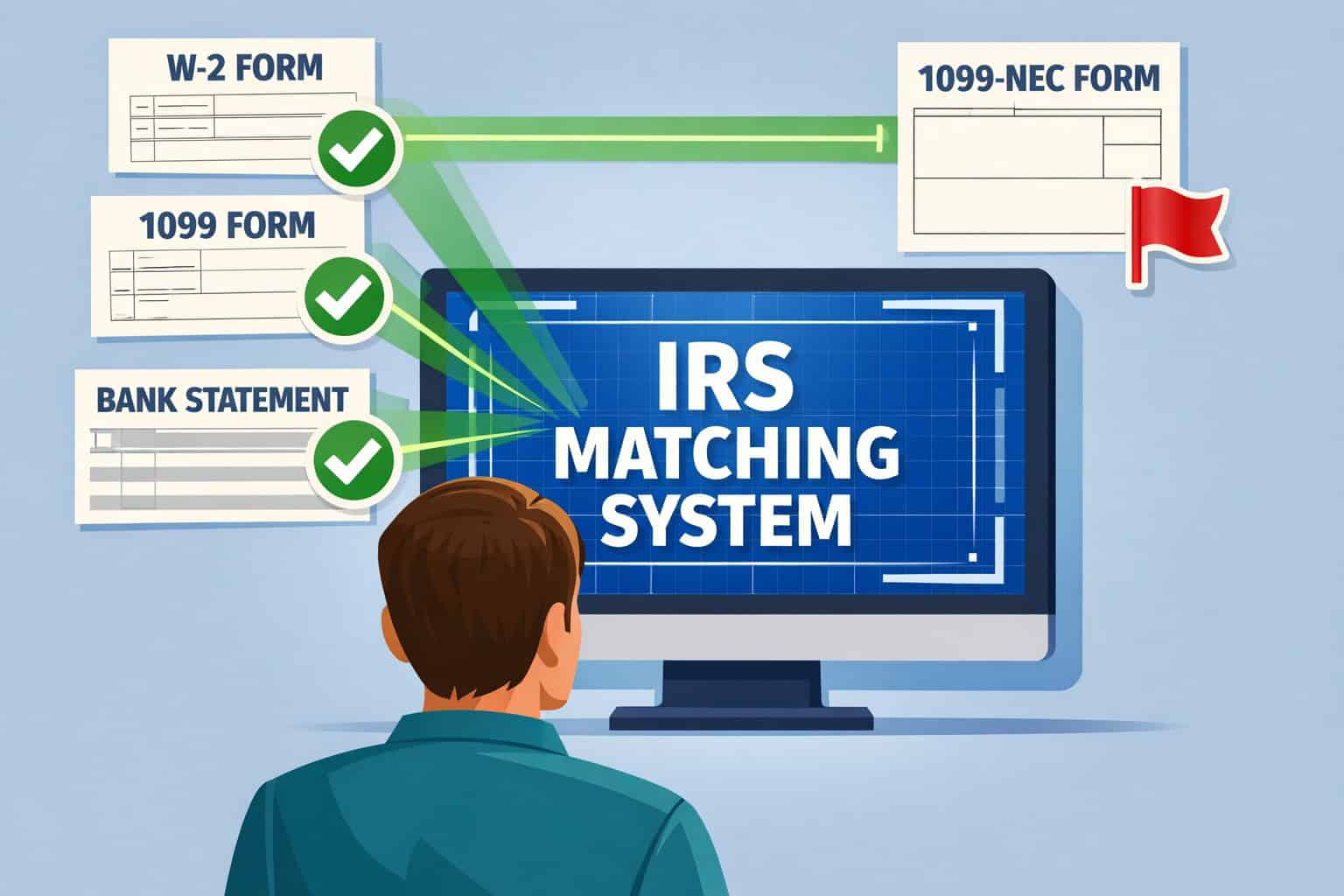
The IRS receives copies of every W-2, 1099, K-1, and other information return sent to you. Their computers match these documents against your return automatically often within 48 hours of filing.
A missing or misstated Form 1099, K-1, or crypto-exchange statement virtually guarantees a CP2000 notice and an accuracy penalty.
Common sources of income the IRS tracks:
| Source of Income | Form |
|---|---|
| Regular wages | W-2 |
| Interest | 1099-INT |
| Dividends | 1099-DIV |
| Independent contractor income | 1099-NEC |
| Payments from apps (PayPal, Venmo) | 1099-K |
| Social Security | SSA-1099 |
| Retirement distributions | 1099-R |
| Stock sales | 1099-B |
| Cryptocurrency transactions | 1099-DA (new for 2026) |
| Partnership/trust income | Schedule K-1 |
What to do:
Before filing, obtain all your income documents. The IRS expects to match roughly 3.5 billion information documents to returns during the 2025 filing season. If you’re missing a document, request a copy or check your wage-and-income transcript through the IRS website.
2. HIGH INCOME LEVELS
The Trigger:
The IRS focuses more attention on higher-income returns because that’s where the potential tax gap is largest. Taxpayers with more than $5 million in income were by far the most likely households to be audited in 2022.
Under current IRS plans, partnerships with assets over $10 million will see audit rates increase tenfold by 2026. The agency is prioritizing more complex returns for higher-wealth entities.
What to do:
If you’re in a higher income bracket, expect more scrutiny. Maintain impeccable records and consider working with a tax professional who specializes in complex returns.
3. ROUND NUMBERS AND “PERFECT” RATIOS
The Trigger:
Returns where expenses repeatedly end in “000” are immediate audit candidates. The modern DIF algorithm flags distributions that look more like human estimation than meticulous record-keeping.
The IRS discourages using rounded numbers because they suggest estimation rather than actual documented amounts. Rounded figures may signal poor recordkeeping or missing documentation, which could be viewed as deceptive during an audit.
What to do:
Use accurate numbers from receipts, not estimates. Real expenses have odd numbers. If all your deductions end in .00, you’re inviting a closer look.
4. REPEATED BUSINESS LOSSES
The Trigger:
A business is generally expected to turn a profit. If you file a Schedule C and report a loss year after year, the IRS may decide your business is actually a hobby.
Three consecutive loss years (or two of seven for equine activities) create a rebuttable presumption of a hobby under IRS rules. If the IRS reclassifies your activity as a hobby, you may lose those deductions entirely and be hit with a bill for back taxes and interest.
What to do:
Document your profit motive. Keep a business plan, marketing materials, and contemporaneous logs showing you’re actively trying to make money. You can claim losses every year if that’s truly what happened, but be prepared to prove you’re operating as a business, not a hobby.
5. 100% BUSINESS VEHICLE USE
The Trigger:
It is rare for a car to be used exclusively for work, and the IRS is well aware of this reality. If you claim that your primary vehicle is used 100% for business, the agency may suspect you are trying to write off personal commuting or grocery runs.
Unless you have a specialized vehicle, like a delivery truck that stays at a job site, claiming total business use is a red flag.
What to do:
Keep a detailed mileage log that clearly separates your professional trips from your personal errands. Claiming 100 percent business use of a vehicle that you also use personally is a red flag. Maintain a log for both business and personal miles driven.
6. UNUSUALLY LARGE CHARITABLE DEDUCTIONS
The Trigger:
The IRS monitors the ratio of donations to income. If you earn $50,000 and claim $20,000 in charitable donations, your return stands out for further review.
Field agents are likely to deny the entire deduction without adjusting value when the taxpayer fails to meet strict substantiation rules.
Documentation requirements:
- For any donation over $250, you need a written acknowledgment from the charity
- Contributions of property valued above $5,000 require Form 8283 Section B and a qualified appraisal dated within sixty days of the donation
- Curator letters, Zillow printouts, and standard receipts are not considered appraisals
What to do:
Keep receipts, acknowledgments, and appraisals for all significant donations. And be aware that charitable deductions are capped at 60% of your adjusted gross income for cash donations and 30% of AGI for stocks and other property.
7. CRYPTOCURRENCY AND DIGITAL ASSET TRANSACTIONS
The Trigger:
The days of cryptocurrency being the Wild West for taxes are over. The IRS now asks a direct question on the front of Form 1040 about digital assets.
Starting in 2026, new reporting rules for brokers mean the IRS will receive even more data on your crypto trades through Form 1099-DA.
If you sold, exchanged, or even used digital currency to buy a cup of coffee, you must report it. Failing to check that box or underreporting gains is a high-priority enforcement area for the agency.
What to do:
Answer the digital asset question honestly. Maintain accurate records of every transaction, including dates, amounts, fair market value, and what you acquired. If you’re actively trading, consider specialized crypto tax software.
8. HOME OFFICE DEDUCTION MISTAKES
The Trigger:
This is a common misconception—the home office deduction itself doesn’t trigger audits unless the expenses are excessively high or the claim is unusual for your type of business.
However, many people claim it incorrectly. To qualify, your space must be used regularly and exclusively for business. If your home office also serves as a guest room or a playroom for your kids, it doesn’t meet the criteria.
Important: Unless you’re self-employed and conduct the majority of your business from your home, you cannot deduct any home-office expenses. Regular employees don’t qualify, even if they pay out of pocket for all or part of their home-office setup.
What to do:
If you qualify, ensure the area is a clearly defined, dedicated workspace. Keep photos or a floor plan to document your claim. Calculate the deduction properly using either the simplified method or actual expenses method.
ADDITIONAL TRIGGERS TO KNOW
Cash-intensive businesses: Restaurants, salons, contractors, and others operating heavily in cash are often scrutinized for underreporting.
Foreign accounts: If you hold bank accounts or assets outside the United States with aggregate value exceeding $10,000, you may be required to file an FBAR. Failing to report these accounts can trigger a deeper look.
Refundable credits: The IRS audits returns claiming Earned Income Tax Credit, Child Tax Credit, and American Opportunity Credit at higher rates due to past fraud.
Inconsistent information: A single digit out of place in a Social Security number, an EIN that fails to match IRS records, or an address inconsistent with last filing will stall an e-file submission and may route your return for correspondence examination.
THE BOTTOM LINE
The best way to handle an audit is to prevent one from happening in the first place. By double-checking your math, reporting every dollar of income, and keeping receipts for every deduction, you significantly lower your risk.
Even if you hire a tax professional to prepare your return, the accuracy of your filing ultimately falls on your shoulders. Review your return before signing.
If you do receive a letter from the IRS, don’t panic. Many audits are conducted entirely through the mail and can be resolved by simply providing the documentation you already have on hand. Staying organized throughout the year is your best defense.

READY TO AUDIT-PROOF YOUR RETURN?
VISIT wealthintelreport.com for More guide
FOLLOW @wealth Intel on TikTok for daily tax truth bombs that actually keep your money safe.
DISCLAIMER: For educational purposes only, not tax advice or legal guidance. Tax laws change frequently; individual circumstances vary. No return is immune from examination. Consult a qualified tax professional before making decisions. wealthintelreport.com and @wealth Intel assume no liability
https://shorturl.fm/1gWzQ