


INTRODUCTION
There’s a question every investor must answer:
Do you want your tax break today, or tomorrow?
It sounds simple. A preference. A timing choice.
But buried inside that question is the single biggest determinant of how much retirement income you’ll actually keep.
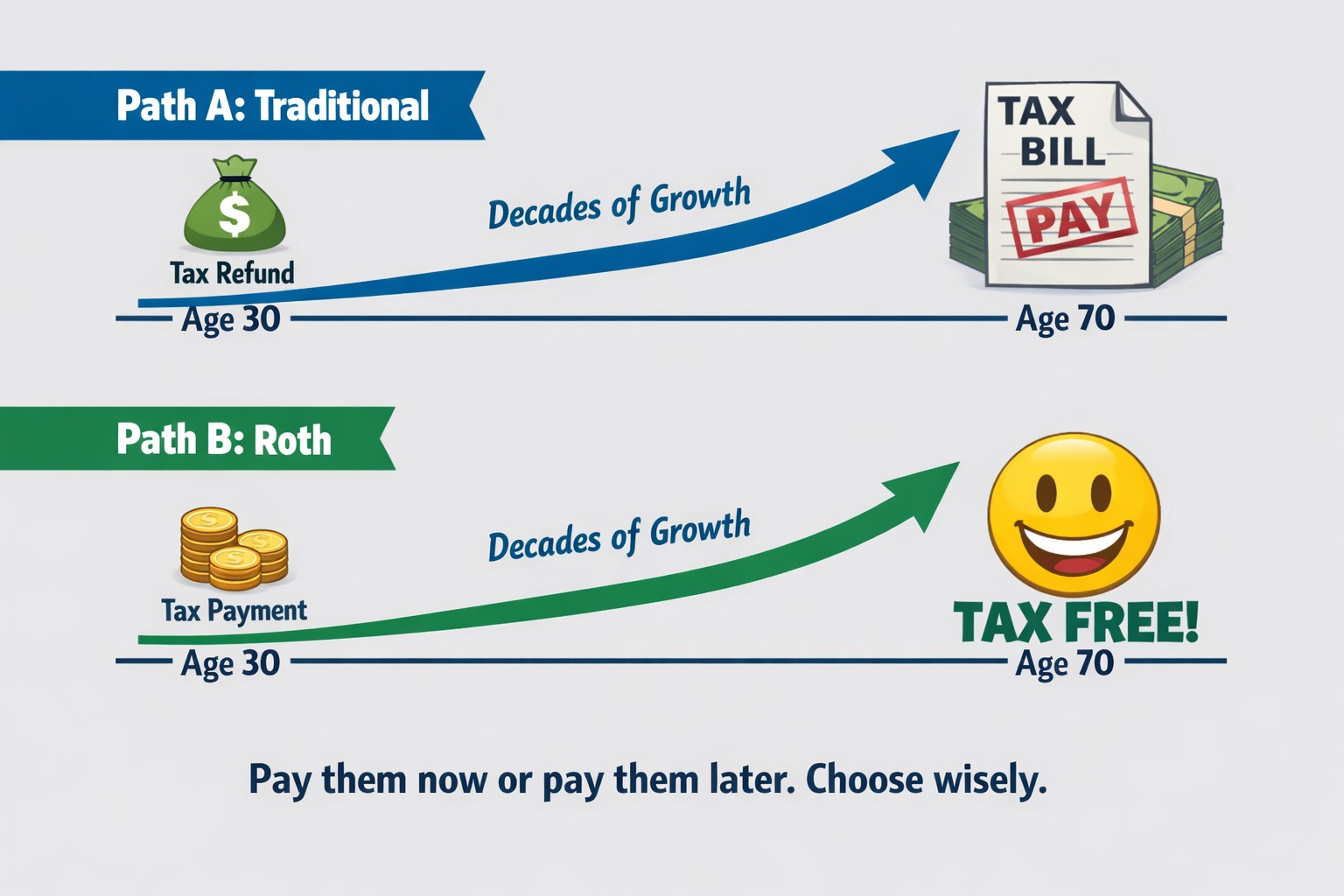
The Traditional IRA says: “Let us lower your taxes now. You pay us later, when you’re retired and (presumably) in a lower bracket.”
The Roth IRA says: “Pay us now. Get its out of the way. Then never think about taxes on this money again. Ever.”
Both are powerful. Both have passionate advocates. And choosing wrong can cost you six figures over a lifetime.
Let’s break down exactly how these accounts work, how they differ, and how to decide which one (or which combination) builds the most wealth for YOUR specific situation.
WHAT IS A TRADITIONAL IRA?
A Traditional IRA (Individual Retirement Account) is a tax-advantaged account that lets you contribute pre-tax dollars.
Here’s how it works:
You contribute money that hasn’t been taxed yet. Let’s say you earn $60,000 and contribute $6,000 to a Traditional IRA. The IRS pretends you only earned $54,000 for the year. Your taxable income drops. You pay less tax today. Maybe you get a bigger refund.
That money then grows inside the account. Dividends. Capital gains. Interest. All of it compounds tax-DEFERRED. You don’t pay a penny in taxes on the growth while it’s happening.
Then retirement comes.
You start withdrawing money. And NOW the IRS wants their share. Every dollar you pull out both your original contributions AND all the growth gets taxed as ordinary income. Whatever your tax bracket is in retirement, that’s what you pay.
The Traditional IRA is essentially a tax DEFERMENT vehicle, not a tax AVOIDANCE vehicle. You’re pushing today’s tax bill into the future, betting that future you will be in a lower bracket.
WHAT IS A ROTH IRA?
A Roth IRA is also a tax-advantaged retirement account, but it works in reverse.
You contribute money that’s already been taxed. No deduction today. Your $60,000 income with a $6,000 Roth contribution? You pay taxes on the full $60,000. The IRS gets their cut now.
But then something beautiful happens.
That money grows. And grows. And grows. For decades, potentially. Dividends reinvest. Capital gains compound. The account swells.
And when you retire? Every single dollar is yours.
Not just your contributions. Not just the first layer of growth. EVERYTHING. You can withdraw $100,000 per year and pay ZERO tax on it. It doesn’t show up on your tax return. It doesn’t push Social Security into being taxed. It doesn’t affect Medicare premiums. It’s invisible to the tax system entirely.
The Roth IRA is tax FREEDOM, purchased with today’s dollars.
8 KEY DIFFERENCES BETWEEN ROTH AND TRADITIONAL IRA
1. TAX TIMING
Traditional IRA: You get the tax break today. Your contribution reduces your current taxable income. You feel the benefit immediately either in a bigger refund or smaller tax bill.
Roth IRA: You pay taxes today. No immediate benefit. But every dollar of growth forever is tax-free. You’re trading a certain benefit now for an uncertain (but potentially much larger) benefit later.
2. QUALIFIED WITHDRAWALS
Traditional IRA: Every withdrawal is taxable as ordinary income. Every single dollar. The IRS is your silent partner in every distribution, taking their share based on whatever bracket you land in that year.
Roth IRA: Qualified withdrawals are completely tax-free if you’re over 59½ AND the account has been open at least 5 years. Not partially tax-free. Not mostly tax-free. COMPLETELY tax-free. The IRS has no claim to a single penny.
3. REQUIRED MINIMUM DISTRIBUTIONS (RMDs)
Traditional IRA: At age 73, the IRS forces you to start withdrawing money. They calculate a required minimum distribution based on your age and account balance. You MUST take it, whether you need the money or not. Why? Because they want their tax revenue.
Roth IRA: No RMDs. Ever. You can let the money grow untouched for your entire life. Pass it to your spouse. Pass it to your children. Let it compound for decades beyond your own lifetime. The Roth is the only retirement account that truly never forces your hand.
4. INCOME LIMITS FOR CONTRIBUTIONS
Traditional IRA: Anyone with earned income can contribute. However, the tax DEDUCTION phases out if you (or your spouse) have access to a workplace retirement plan like a 401(k). For 2024:
- Single filers with workplace plan: Deduction phases out $77,000-$87,000
- Married filing jointly with workplace plan: Phases out $123,000-$143,000
- No workplace plan? Full deduction regardless of income.
Roth IRA: Direct contributions phase out at higher incomes:
- Single filers: $146,000-$161,000 (2024)
- Married filing jointly: $230,000-$240,000 (2024)
But here’s the loophole: Backdoor Roth IRA. High earners can contribute to a Traditional IRA (non-deductible) and immediately convert to Roth. It’s legal. It’s allowed. And it’s how wealthy people still get Roth benefits.
5. EARLY WITHDRAWAL RULES
Traditional IRA: Withdraw before 59½ and you pay ordinary income tax PLUS a 10% penalty. There are exceptions (first-time homebuyer, qualified education expenses, certain medical expenses), but generally, your money is locked up.
Roth IRA: You can withdraw your CONTRIBUTIONS anytime, for any reason, completely tax-free and penalty-free. The growth is locked until 59½ (with exceptions), but your original dollars are always accessible. This makes the Roth a powerful hybrid retirement account AND emergency fund in one.
6. IMPACT ON OTHER TAXABLE INCOME
Traditional IRA: Withdrawals count as income. They can push Social Security benefits into being taxed. They can increase Medicare premiums (IRMAA surcharges). They can bump you into higher tax brackets. Your RMDs can create a domino effect of tax consequences.
Roth IRA: Withdrawals don’t count as income for ANY purpose. Not for Social Security taxation. Not for Medicare premium calculations. Not for bracket determination. A dollar from your Roth is invisible to the entire tax and benefit system.
7. ESTATE PLANNING AND HEIRS
Traditional IRA: Heirs inherit your IRA but must pay taxes on every dollar they withdraw. Under the SECURE Act, most non-spouse heirs must empty the account within 10 years, potentially creating massive tax bills if they’re in their peak earning years.
Roth IRA: Heirs inherit TAX-FREE money. They still must follow distribution rules (10 years for most non-spouse heirs), but every dollar they withdraw is completely tax-free. A Roth is the ultimate wealth transfer vehicle—tax-free growth for your beneficiaries.
8. TAX RATE UNCERTAINTY
Traditional IRA: You’re betting your future tax rate will be LOWER than your current rate. For many retirees, that’s true. You stop working. Your income drops. You fall into lower brackets. Traditional wins.
Roth IRA: You’re betting your future tax rate will be HIGHER than your current rate. Given historical tax rates (much higher in the past) and current national debt levels, many experts believe rates have nowhere to go but up. Roth locks in today’s historically low rates.
THE DECISION FRAMEWORK: HOW TO CHOOSE
Here’s the simple framework financial planners use:
Choose Traditional IRA IF:
1. You’re in a high tax bracket now.
If you’re paying 32% or 35% today and expect to be in 12% or 22% in retirement, take the deduction now. The math heavily favors Traditional.
2. You need the tax break to afford contributing.
If the choice is “contribute to Traditional with deduction” or “don’t contribute at all,” Traditional wins every time. Something beats nothing.
3. You expect significantly lower income in retirement.
If your retirement plan involves a paid-off house, modest expenses, and minimal taxable income, Traditional lets you fill those low brackets with withdrawals.
4. You’re close to retirement and RMDs aren’t a concern.
If you’re 60 and retiring at 65, the RMD rules won’t affect you for years, and you may prefer the immediate deduction.
Choose Roth IRA IF:
1. You’re in a low tax bracket now.
Paying 12% today to avoid unknown rates later is almost always smart. You’ll never pay less than 12% in taxes for the rest of your life.
2. You’re young and have decades of growth ahead.
A $6,000 Roth contribution at 25 could grow to $100,000+ tax-free by 65. That tax-free compounding is enormously valuable over long time horizons.
3. You expect higher income (and taxes) in retirement.
If you’ll have a pension, rental income, large Traditional IRA RMDs, or other taxable income, Roth gives you tax-free money to balance your tax picture.
4. You want maximum flexibility and estate planning benefits.
The ability to withdraw contributions, avoid RMDs, and pass tax-free wealth to heirs makes Roth uniquely powerful.
The “Both” Strategy:
For many people, the answer isn’t either/or it’s both.
Contribute to Traditional to lower your tax bill now. Contribute to Roth to build tax-free flexibility later. In retirement, you can strategically withdraw from each to manage your tax bracket:
- Use Traditional withdrawals to fill the lower brackets (up to the top of 10% or 12%)
- Use Roth withdrawals for anything above that, avoiding higher tax rates
- Manage RMDs by spending down Traditional accounts or doing Roth conversions in low-income years
A mix gives you tax diversification the ability to adapt to whatever tax landscape the future holds.
REAL NUMBERS EXAMPLE
Let’s compare $6,000 annual contributions for 30 years, 7% annual return:
Scenario A: 24% tax bracket now, 12% bracket in retirement
Traditional IRA:
- Contribution grows to approximately $566,000
- After 12% tax = $498,000 spendable
Roth IRA:
- Pay $1,440 tax each year on the contribution ($6,000 × 24%)
- After 30 years, you have $566,000 tax-free
Traditional wins by about $68,000 because you avoided 24% tax now to pay only 12% later.
Scenario B: 22% tax bracket now, 24% bracket in retirement
Traditional IRA:
- $566,000 minus 24% tax = $430,000 spendable
Roth IRA:
- Pay $1,320 tax each year ($6,000 × 22%)
- After 30 years, $566,000 tax-free
Roth wins by about $136,000 because you locked in 22% to avoid 24% later.
Scenario C: 22% bracket now AND later (rates unchanged)
Traditional IRA:
- $566,000 minus 22% tax = $441,480
Roth IRA:
- Pay $1,320 tax each year
- $566,000 tax-free
Roth still wins slightly because the tax-free growth on investment earnings (not just contributions) adds value. And you avoided RMDs and gained flexibility.
THE BACKDOOR ROTH STRATEGY
If your income exceeds the Roth contribution limits, you’re not locked out.
The Backdoor Roth IRA is a two-step process:
- Contribute to a Traditional IRA (non-deductible, since your income is too high)
- Immediately convert that Traditional IRA to a Roth IRA
You pay tax on any growth between contribution and conversion (minimal if done quickly). But otherwise, your money moves into the Roth, where it grows tax-free forever.
This is completely legal. It’s used by millions of high earners. And it’s why “Roth IRA income limits” don’t have to stop you.
FINAL THOUGHT
The Roth vs. Traditional debate isn’t about which account is “better.”
It’s about when you want to pay taxes.
Traditional says: “Pay me later. I trust future me will be in a lower bracket.”
Roth says: “Pay me now. Get it over with. Then enjoy freedom forever.”
The right answer depends on your current bracket, your expected future bracket, and how much flexibility you want.
But here’s the secret the wealthy know:
Tax diversification beats tax prediction every time.
Having both types of accounts lets you adapt. Withdraw from Traditional in low-income years. Pull from Roth when you’d otherwise jump brackets. Manage RMDs strategically. Leave tax-free wealth to heirs.
You don’t have to predict the future. You just have to prepare for multiple futures.

READY TO OPTIMIZE YOUR RETIREMENT ACCOUNTS?
VISIT wealthintelreport.com for our free IRA Optimizer Tool. Answer 5 questions about your income, age, and goals, and we’ll tell you exactly which IRA strategy fits your situation.
FOLLOW @wealth Intel on TikTok for daily wealth-building content that actually moves the needle.
DISCLAIMER
This content is for educational purposes only and not tax or financial advice. IRA rules change frequently; Backdoor Roth strategies have additional considerations if you have existing pre-tax IRA balances. Consult a qualified tax professional before making retirement decisions. wealthintelreport.com and @wealth Intel assume no liability for actions based on this information.