

INTRODUCTION
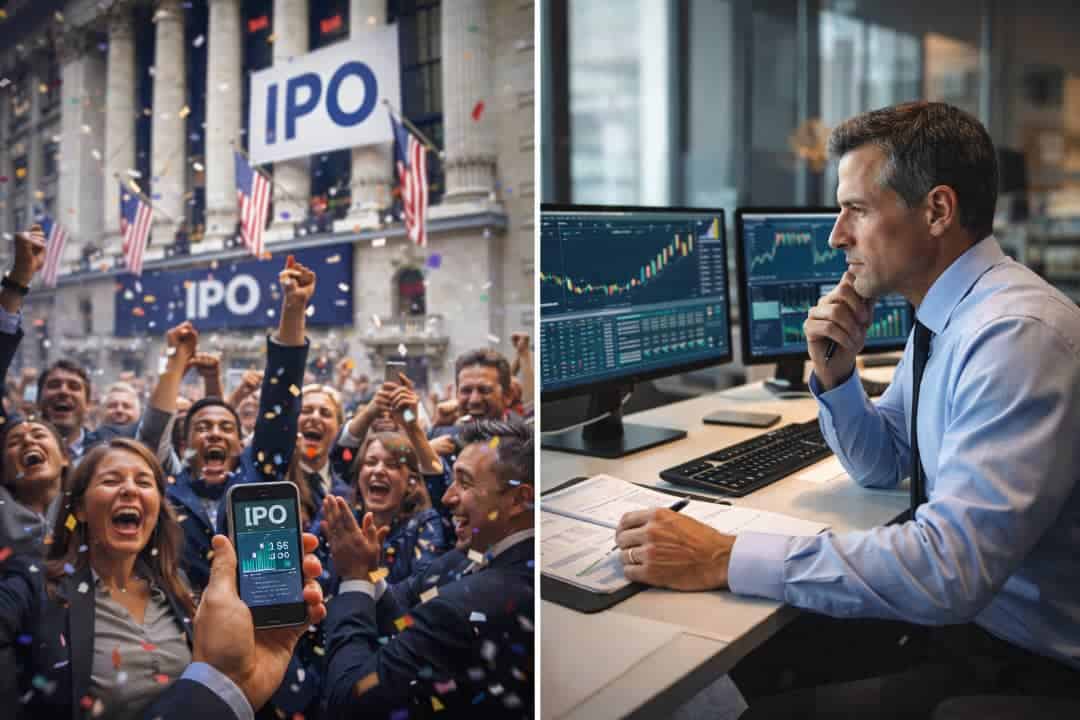
There’s something intoxicating about an IPO.
The buzz. The exclusivity. The chance to say “I got in on the ground floor.” It feels like being invited to the VIP section of the financial world while everyone else waits outside.
But here’s what the marketing doesn’t tell you:
The “ground floor” might actually be the penthouse.
When a company goes public, the people who benefit most aren’t retail investors like you and me. They’re the insiders. The bankers. The institutional investors who get first dibs at prices the public never sees.
Meanwhile, the secondary market, the boring, everyday exchange where stocks actually trade, is where real price discovery happens. Where hype meets reality. Where patient investors find opportunities that the IPO crowd missed entirely.
Let’s break down exactly why these two markets are different and why waiting might be the smartest move you ever make.
WHAT IS AN IPO?
IPO stands for Initial Public Offering.
It’s the first time a private company offers its shares to the public. Before this moment, the company was owned by founders, early employees, and venture capital firms. After the IPO, anyone with a brokerage account can theoretically own a piece.
But here’s the catch: you’re not actually buying from the company in the way you think.
When you participate in an IPO, you’re part of a carefully orchestrated process. Investment bankers (think Goldman Sachs and Morgan Stanley) work with the company to determine an initial price. They allocate shares to their biggest clients—pension funds, mutual funds, and hedge funds. These are the institutions that get the real allocation.
Retail investors? You get whatever’s left. If anything.
The IPO price is designed to do two things:
- Raise as much money as possible for the company
- Give institutional investors enough “pop” on day one to keep them happy
Notice what’s missing from that list? Making YOU rich.
WHAT IS THE SECONDARY MARKET?
The secondary market is where stocks go to live their actual lives.
After the IPO is complete, shares begin trading on exchanges like the New York Stock Exchange or NASDAQ. From this moment forward, every single trade happens between investors—not between investors and the company.
You buy from someone selling.
You sell to someone buying.
The company isn’t involved at all.
This is where 99.9% of your trading happens. Every time you open your brokerage app and click “buy,” you’re participating in the secondary market. You’re buying shares that have already been issued from someone who already owned them.
The secondary market is brutally honest. It doesn’t care about hype. It doesn’t care about the company’s Instagram account or the CEO’s charisma. It cares about earnings, growth, debt, competition, and a thousand other factors that determine what a business is actually worth.
8 KEY DIFFERENCES BETWEEN IPO AND SECONDARY MARKET
1. WHO SETS THE PRICE
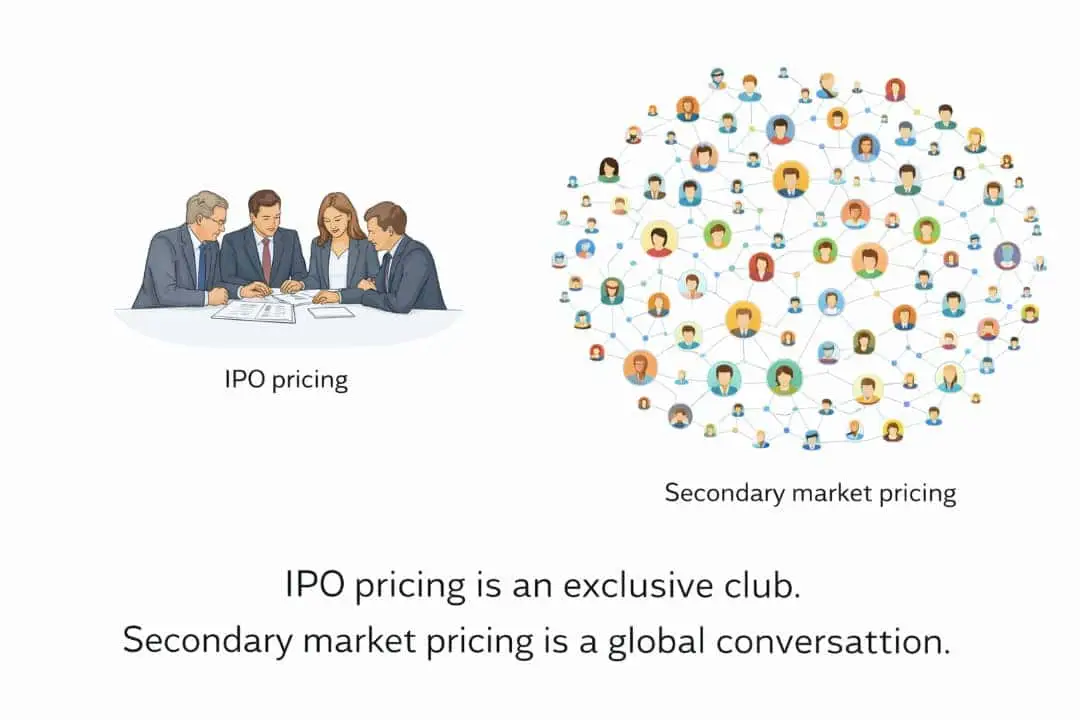
IPO: Investment bankers set the price behind closed doors. They interview institutional investors, gauge demand, and choose a number that balances company fundraising goals with the need to create a “successful” first-day pop. You have zero input.
Secondary Market: Millions of buyers and sellers set the price in real-time. Every trade is a vote. Every transaction is a consensus between what someone will pay and what someone will accept. This is democracy. This is discovery.
2. LIQUIDITY AND LOCK-UPS
IPO: When you buy IPO shares, you typically cannot sell them for 90 to 180 days. This is the lock-up period, designed to prevent early investors from dumping shares immediately. If the stock drops during this period? You’re stuck.
Secondary Market: You can sell whenever you want. Literally. Buy at 9:30am, change your mind at 9:32am, and sell at 9:33am. Your money is yours. Your decisions are yours. No lock-up agreement holds you hostage.
3. INFORMATION AVAILABILITY
IPO: The company provides a document called an S-1 or prospectus. It contains information, yes. But it’s carefully crafted by lawyers and bankers to present the company in the best possible light. There’s no trading history. No pattern of how the stock reacts to news. No data.
Secondary Market: You get trading history. You get patterns. You get years of data showing how the stock behaves during earnings, during market downturns, and during sector rotations. Information compounds over time.
4. ACCESS AND ALLOCATION
IPO: Allocation is deeply unfair. Institutional investors get the vast majority of shares. Retail investors get scraps often only after institutions have taken their fill. Your “IPO access” through Robinhood or other apps? Those are shares institutions didn’t want.
Secondary Market: Everyone gets the same access. The price you see is the price everyone sees. Your $1,000 buys the same shares as a hedge fund’s $10 million. No phone calls. No special treatment. Just pure, equal access.
5. VOLATILITY AND PRICE SWINGS
IPO: First-day volatility can be extreme. Stocks can pop 50% or drop 20% in hours. But because of lock-ups, you can’t even trade if you wanted to. You’re watching from the sidelines as your investment fluctuates wildly with zero ability to react.
Secondary Market: Volatility exists, absolutely. But you can actually DO something about it. Take profits. Cut losses. Add to positions. The ability to act is itself a form of risk management that IPO investors don’t have.
6. HISTORICAL PERFORMANCE
IPO: The data is sobering. According to research from Arizona State University, from 1980 to 2020, investing in IPOs on the first day and holding for five years would have underperformed the market by about 3% annually. The hype doesn’t last.
Secondary Market: Patient investors who wait 3-5 years after an IPO often find better entry points. By then, the stock has found its real value. The hype is gone. The story is either proving itself or failing.
7. EMOTIONAL STATE OF PARTICIPANTS
IPO: Buyers are often driven by FOMO. The fear of missing the “next big thing.” The desire to tell friends you were early. These are terrible reasons to invest money. Emotions drive decisions, and emotions destroy wealth.
Secondary Market: You can be calm. You can be patient. You can watch, wait, and decide with a clear head. No one’s rushing you. No countdown clock. Just you, the data, and your own timeline.
8. WHO BENEFITS MOST
IPO: The company benefits. The bankers benefit. Early investors who’ve been waiting years to cash out benefit. Retail investors? You’re paying for their party.
Secondary Market: Patient investors benefit. People who do their own research benefit. Those who wait for the hype to die and value to emerge benefit. The game is different, and the winners are different.
SO WHAT SHOULD YOU ACTUALLY DO?
Here’s a simple framework:
1. Never buy an IPO on the first day.
Just don’t. The odds are stacked against you. The pricing benefits insiders. The volatility is unpredictable. You have no track record to analyze. Skip it.
2. Add the stock to a watchlist.
Let it trade for 3-6 months minimum. Watch how it moves. Read the first few earnings reports. See how management handles being a public company.
3. Wait for lock-up expirations.
When insiders can finally sell, there’s often downward pressure. This can create buying opportunities for patient investors.
4. Build your position gradually.
Don’t go all in. Buy a small position. Watch how it behaves. Add more over time as the company proves itself.
5. Treat it like any other stock.
Once it’s been trading for a year, it’s just another company. Evaluate it on fundamentals, not on the “IPO” label.
FINAL THOUGHT
The IPO market sells a story.
The secondary market sells reality.
Stories are exciting. They make great dinner conversation. They feel like being part of something special. But reality builds wealth slowly, quietly, and consistently over decades.
You don’t need the ground floor. You need the right floor. And that floor only reveals itself after the hype fades and the real work begins.
READY TO BUILD YOUR POST-IPO WATCHLIST?
VISIT wealthintelreport.com for our free framework on evaluating companies after they go public. We’ve built a simple checklist that helps you separate hype from value, so you never overpay for a story again.
FOLLOW @wealth Intel on TikTok for daily breakdowns that actually build wealth.
DISCLAIMER
This content is for educational purposes only and not financial advice. IPOs and secondary market trading involve risk, including potential loss of principal. Past performance does not guarantee future results. Always conduct your own research and consult a professional before investing. wealthintelreport.com and @wealthintel are not registered investment advisors and assume no liability.