

INTRODUCTION
The news announces: “The Federal Reserve raised interest rates by 0.25%.”
You nod along, understanding this is important. Maybe you feel a tiny victory; your savings might earn a bit more.
Then your credit card statement arrives. Your minimum payment jumped. Your auto loan feels heavier. That mortgage pre-approval you were eyeing now comes with a higher rate.
What happened?
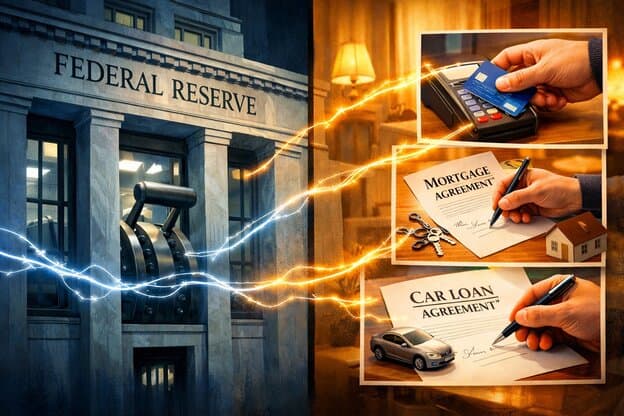
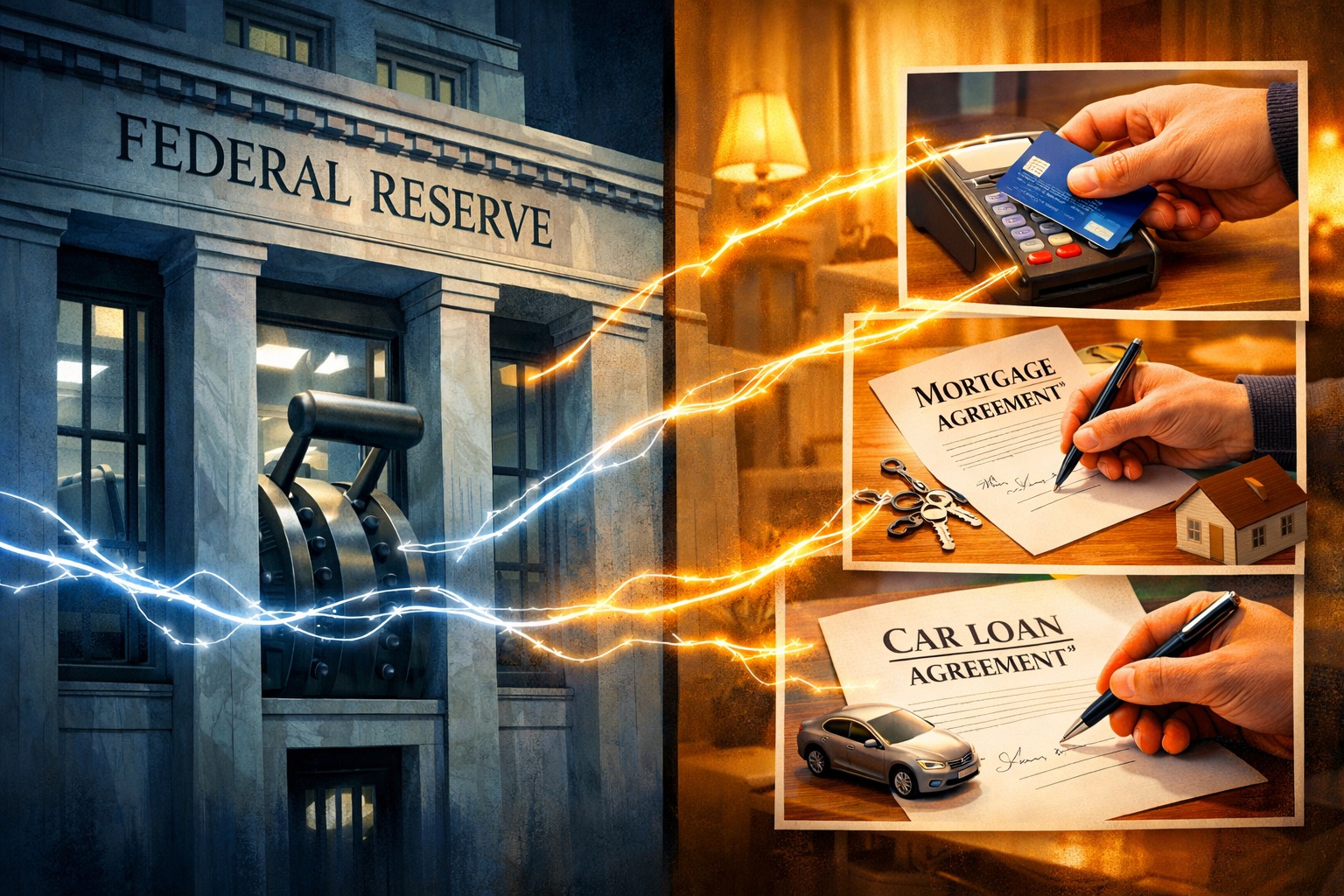
The Fed pulled a lever in Washington. And that lever is connected invisibly but directly to every loan you’ll ever take.
Understanding the connection between the Federal Funds Rate and APR is like understanding the difference between wholesale and retail prices. The Fed sets the wholesale cost of money. What you pay is the retail price.
Here’s how it works, why it matters, and what you can do about it.
WHAT IS THE FEDERAL FUNDS RATE?
The Federal Funds Rate is the interest rate banks charge each other for overnight loans.
Banks are required to hold a certain amount of reserves. At the end of each day, some banks have excess reserves. Others have a shortfall. They lend to each other overnight to balance their books. The interest rate on these loans is the Federal Funds Rate.
The Federal Reserve doesn’t set this rate by decree. Instead, they influence it through monetary policy tools—buying or selling government securities, adjusting the interest they pay on bank reserves, and signaling their intentions to markets.
Think of it as the wholesale price of money. It’s what banks pay to borrow from each other. It’s the foundation upon which all other borrowing costs are built.
WHAT IS APR?
APR stands for Annual Percentage Rate.
It’s the comprehensive cost of borrowing money, expressed as a yearly rate. Unlike a simple interest rate, APR includes not just the interest you pay but also any fees, points, or other charges built into the loan.
When you see:
- 24% APR on a credit card
- 6.5% APR on a mortgage
- 8% APR on an auto loan
That’s the retail price of money. It’s what YOU pay after the bank covers its costs, builds in its profit, and accounts for your personal risk.
APR is always higher than the Federal Funds Rate. Sometimes dramatically higher. The gap between them is the banking system’s profit margin and your cost of accessing capital.
8 KEY DIFFERENCES BETWEEN FEDERAL FUNDS RATE AND APR
1. WHO PAYS IT
Federal Funds Rate: Banks pay this to other banks. It’s an interbank lending rate. You never pay this rate directly. You’ll never see it on a statement.
APR: You pay this. Every borrower pays this (or some version of it). It’s on your credit card agreement, your mortgage closing documents, and your auto loan contract.
2. HOW IT’S SET
Federal Funds Rate: Set by the Federal Open Market Committee (FOMC), which meets eight times yearly. They analyze economic data—inflation, employment, and growth and decide the appropriate target range.
APR: Set by individual banks based on:
- The Fed Funds Rate (their cost)
- Their desired profit margin
- Your credit score and risk profile
- Competition from other lenders
- The specific type of loan
3. SPEED OF CHANGE
Federal Funds Rate: Changes at scheduled FOMC meetings. Occasionally emergency meetings. The market often anticipates moves weeks in advance.
APR: Changes instantly for new loans. For variable-rate products (like most credit cards), APR can change within one or two billing cycles after a Fed move. Fixed-rate products lock in the rate at the time of borrowing.
4. VOLATILITY
Federal Funds Rate: Actually quite stable. Moves in small increments (typically 0.25%) and stays there until the next meeting. Predictable and controlled.
APR: Can be volatile, especially for new loans. Mortgage rates bounce daily based on bond market reactions to Fed policy, economic news, and global events. Your credit card APR might be stable for months and then jump suddenly.
5. IMPACT ON BORROWERS
Federal Funds Rate: Zero direct impact. You never pay it. Never see it. Never think about it except when reading financial news.
APR: Direct, immediate, painful impact. A 1% APR increase on a $300,000 mortgage costs you roughly $170 more monthly. On a $10,000 credit card balance, it’s $100 more yearly in interest.
6. IMPACT ON SAVERS
Federal Funds Rate: When the Fed raises rates, banks earn more on their reserves. Their profits potentially increase.
APR: Savers might see small increases in savings account rates—but always slower and smaller than borrowing rate increases. Banks are quick to raise what you pay. Slow to raise what you earn.
7. TRANSMISSION MECHANISM
Federal Funds Rate: Changes ripple through the economy via the banking system. It’s the starting point.
APR: The endpoint. After banks adjust their cost of funds, after they add profit margins, after they assess your creditworthiness, APR is what emerges at the consumer level.
8. CONTROL
Federal Funds Rate: The Fed controls this directly. They have tools and they use them. It’s their primary monetary policy lever.
APR: The Fed influences this but doesn’t control it. Your credit score controls it. The bank’s appetite for risk controls it. Competition in your local market controls it. The Fed sets the stage; your financial health writes your script.
THE TRANSMISSION CHAIN: HOW A FED HIKE REACHES YOUR WALLET
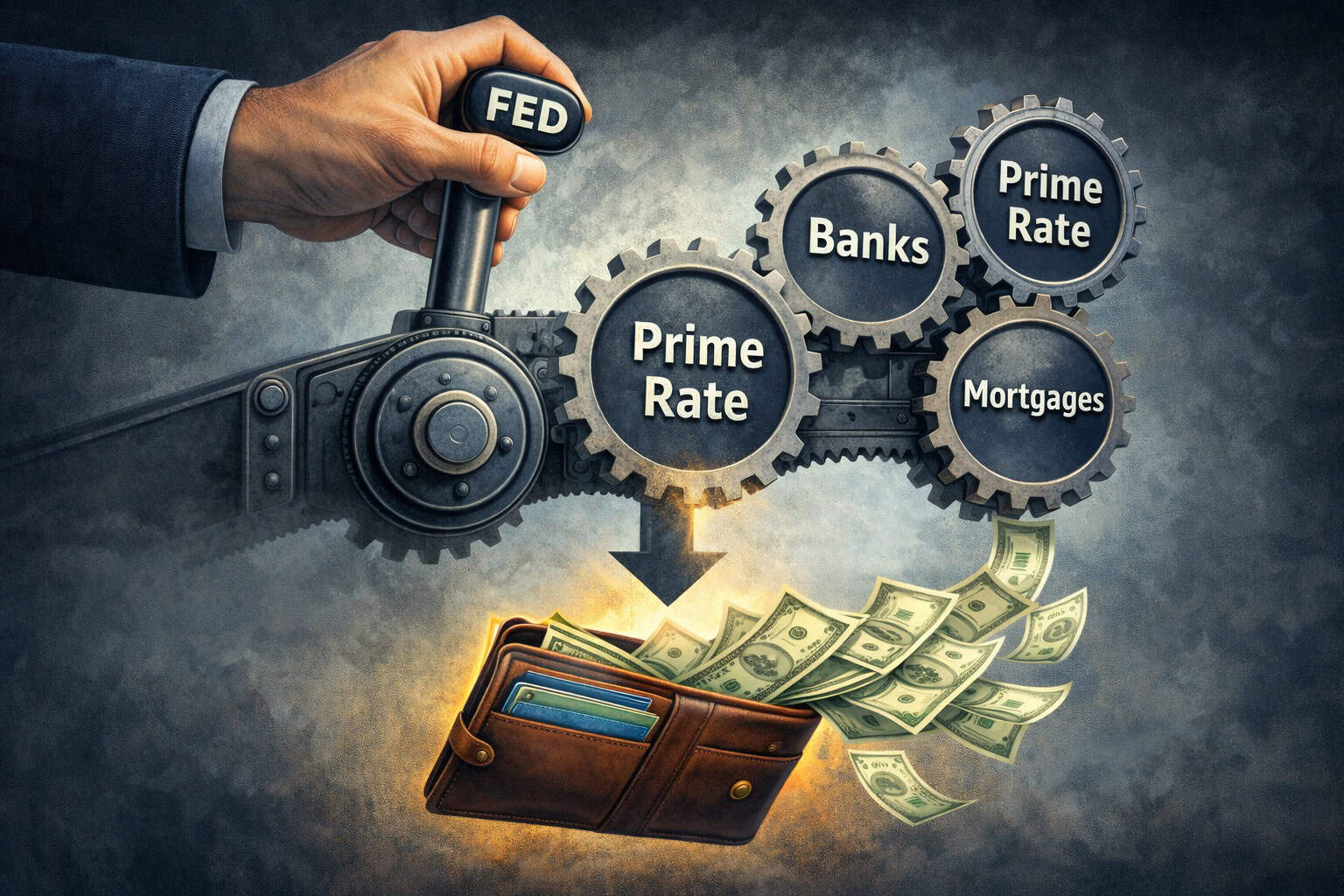
Step 1: Fed raises target rate.
The FOMC announces a 0.25% increase. Banks now pay more to borrow from each other.
Step 2: Bank costs increase.
Banks’ cost of funds rises. Their profit margins shrink if they don’t adjust.
Step 3: Prime Rate rises.
Most banks immediately raise their “prime rate”—the benchmark they use for their best customers. The prime rate typically moves in lockstep with the Fed.
Step 4: Variable-rate products adjust.
Credit cards, HELOCs, and variable-rate loans tied to prime see their APRs increase within 1-2 billing cycles. The notice arrives after the fact.
Step 5: New fixed-rate loans get more expensive.
Mortgage rates, auto loans, and personal loans rise as bond markets react. Even before the Fed hikes, markets anticipate it and rates move.
Step 6: Savings rates crawl upward.
Eventually, some banks raise savings rates. But always slower. Always smaller. The gap between borrowing and saving widens.
REAL NUMBERS EXAMPLE
Before Fed Hikes:
- Fed Funds Rate: 0.25%
- Average Credit Card APR: 16%
- Average 30-Year Mortgage: 3.5%
- Average Savings Account: 0.5%
After 5% in Fed Hikes:
- Fed Funds Rate: 5.25%
- Average Credit Card APR: 21%+
- Average 30-Year Mortgage: 7%+
- Average Savings Account: 1.5-2%
The borrower’s costs jumped dramatically. The saver’s earnings barely budged.
SO WHAT SHOULD YOU DO?
When the Fed signals future hikes:
- Lock in fixed rates on mortgages and auto loans before they rise
- Pay down variable-rate debt aggressively
- Consider whether now is the time to borrow
When the Fed signals future cuts:
- Variable-rate debt becomes cheaper—refinance opportunities appear
- Locking in fixed rates matters less
- Savings rates will fall, so don’t chase yield in bank accounts
Always:
- Monitor your credit score (better score = better APR regardless of Fed)
- Compare offers (competition still matters)
- Understand what type of debt you have (fixed vs. variable)
FINAL THOUGHT
The Federal Funds Rate is the hidden engine.
APR is the speedometer you actually see.
When the Fed presses the accelerator or hits the brakes, you feel it in your payments, your borrowing power, and your financial life. Not because they directly control your rates, but because they control the cost of money at its source.
Understanding that connection doesn’t make the payments smaller. But it does let you anticipate, prepare, and position yourself ahead of the curve.
READY TO MASTER INTEREST RATES?
VISIT wealthintelreport.com for our free Rate-Hikes Survival Guide. We’ll show you exactly how to protect your wallet when the Fed moves rates—whether up or down.
FOLLOW @wealth Intel on TikTok for daily economic truth bombs that actually protect your purchasing power.
DISCLAIMER: For educational purposes only, not financial advice. Fed policy effects on consumer rates vary by lender, creditworthiness, and market conditions. Individual loan terms differ—consult a professional before borrowing. wealthintelreport.com and @wealth Intel assume no liability for decisions made based on this content