


INTRODUCTION
The retirement account debate usually sounds like this:
“Should I open an IRA or just stick with my 401(k) at work?”
It’s a reasonable question. Both accounts offer tax advantages. Both help you build wealth for the future. Both are better than a taxable brokerage account for long-term retirement money.
But here’s what most articles don’t tell you:
This isn’t an either/or decision. It’s a both/and strategy.
The 401(k) and IRA serve different purposes. They have different strengths. They complement each other perfectly when used together. The most financially successful retirees didn’t choose one; they used both strategically over decades.
Let’s break down exactly how each works and why you need both in your life.
WHAT IS A 401(k)?
A 401(k) is an employer-sponsored retirement account.
The name comes from the section of the U.S. tax code that created it. But what matters is how it works:
- You authorize your employer to deduct money from your paycheck before taxes hit it
- That money goes into an account with investments you choose from a pre-selected list
- Your employer may match a portion of your contributions (free money)
- The money grows tax-deferred until withdrawal in retirement
- Withdrawals before age 59½ generally incur a 10% penalty plus taxes
Think of it as the team option. You’re playing by the rules your employer sets. The investment menu is limited. The fees might be higher than ideal. But the employer match makes it incredibly powerful.
WHAT IS AN IRA?
An IRA stands for Individual Retirement Account.
Unlike a 401(k), your employer has nothing to do with it. You open it yourself at any major U.S. brokerage firm: Vanguard, Fidelity, Charles Schwab, or countless others.
Key features:
- You contribute money you’ve already earned (though traditional IRA contributions may be tax-deductible)
- You choose from literally thousands of investments: every stock, every ETF, every mutual fund available at your broker
- You control every aspect of the account
- Tax treatment depends on whether you choose Traditional or Roth
- Same 59½ rule applies for penalty-free withdrawals
Think of it as your personal retirement account. No employer involvement. No limited menu. Just you and your money.
8 KEY DIFFERENCES BETWEEN 401(k) AND IRA
1. THE EMPLOYER MATCH (FREE MONEY)
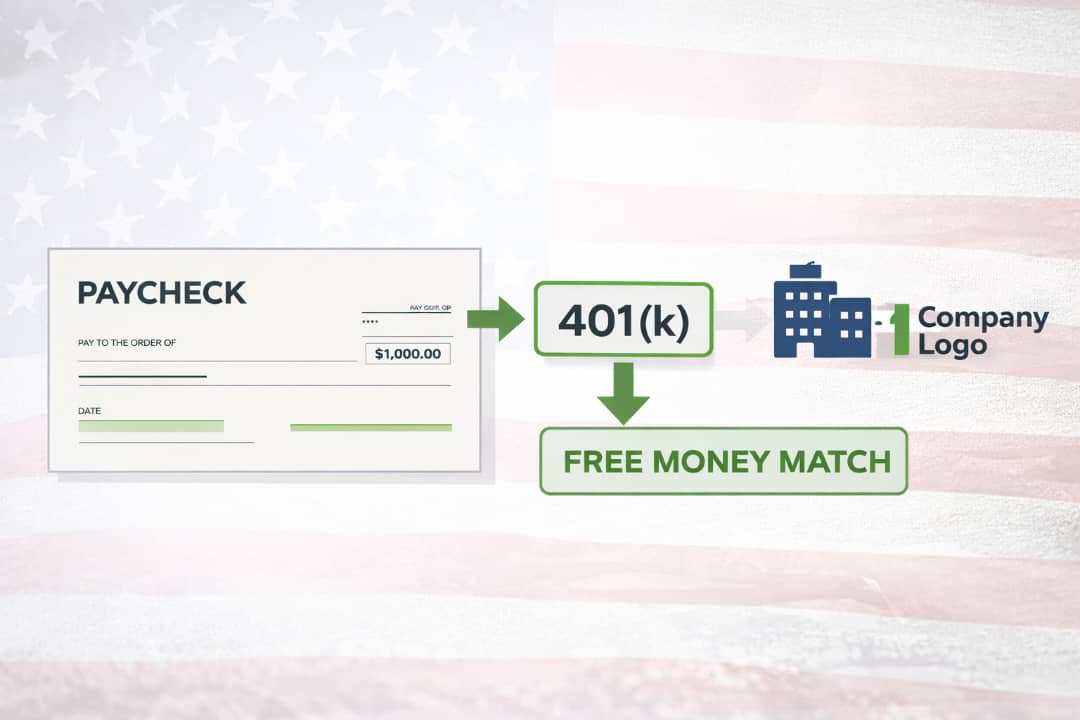
401(k): Many U.S. employers offer to match your contributions up to a certain percentage. Common formulas: 50% of your contributions up to 6% of your salary, or 100% of your contributions up to 3%. This is an immediate 50-100% return on your money before the market even moves. If you’re not contributing enough to get the full match, you’re leaving money on the table. Literally.
IRA: No employer match possible. It’s just you and your money. No free money from anyone. This is why the 401(k) always comes first, at least up to the match.
2. INVESTMENT CHOICES
401(k): You’re limited to whatever investments your employer’s plan offers. Typically 20-30 mutual funds. Some are good. Some have high fees. You cannot buy individual stocks. You cannot buy most ETFs. You cannot venture outside the pre-approved menu.
IRA: You can invest in virtually anything available at your brokerage. Individual stocks like Apple, Microsoft, Tesla. Thousands of ETFs. Bonds. REITs. International equities. Sector funds. The entire U.S. and global investable universe is open to you.
3. CONTRIBUTION LIMITS (2024)
401(k): You can contribute up to $23,000 if you’re under 50. If you’re 50 or older, you can add an extra $7,500 in catch-up contributions, bringing your total to $30,500. These limits are per person, not per household.
IRA: You can contribute up to $7,000 if you’re under 50. If you’re 50 or older, catch-up contributions allow up to $8,000 total. These limits are shared across all your IRAs—you cannot contribute $7,000 to a Traditional IRA and another $7,000 to a Roth IRA in the same year.
The 401(k) clearly wins on raw capacity. You can pack much more money into a 401(k) each year.
4. FEES AND EXPENSES
401(k): Plans have multiple layers of fees. Administrative fees cover record-keeping, legal, and compliance costs. Investment fees cover the mutual funds themselves. Some plans pass these costs directly to participants. You may not even see them itemized.
IRA: At a low-cost U.S. broker like Vanguard, Fidelity, or Schwab, account fees can be zero. Investment fees are whatever you choose, as low as 0.03% for index funds like VOO or IVV. You have complete control over what you pay.
5. ROTH OPTIONS AND INCOME LIMITS
401(k): Many plans now offer a Roth 401(k) option. You contribute after-tax money, and qualified withdrawals in retirement are completely tax-free. The key advantage: Roth 401(k) has no income limits. High earners who cannot contribute directly to a Roth IRA can use the Roth 401(k) as a backdoor.
IRA: Roth IRA has income limits. For 2024, single filers with modified AGI above $161,000 cannot contribute directly. Married couples filing jointly phase out above $240,000. If you earn too much, you need workarounds (like the Backdoor Roth IRA strategy popularized by U.S. finance experts).
6. LOANS AND WITHDRAWALS
401(k): Some U.S. plans allow you to borrow from your 401(k). You can take a loan (typically up to $50,000 or 50% of your vested balance) and repay yourself with interest. The interest goes back into YOUR account. But if you leave your job, the loan becomes due immediately, a trap that catches many Americans.
IRA: No loans allowed. You cannot borrow from an IRA. You can withdraw money, but withdrawals before 59½ trigger taxes plus a 10% penalty (with exceptions for certain situations like first-time home purchase up to $10,000 or qualified education expenses).
7. REQUIRED MINIMUM DISTRIBUTIONS (RMDs)
401(k): Required Minimum Distributions begin at age 73 under current U.S. law (for those turning 72 after 2022). You must withdraw a certain percentage each year, whether you need the money or not. These withdrawals are taxable.
IRA: Same RMD rules apply to Traditional IRAs. However, Roth IRAs have NO RMDs during the original owner’s lifetime. Your money can keep growing tax-free indefinitely if you don’t need it. This is a massive estate planning advantage for Americans.
8. CREDITOR PROTECTION
401(k): Federal law (ERISA) provides strong protection for 401(k) assets against creditors and bankruptcy. Your 401(k) is generally untouchable in lawsuits or bankruptcy proceedings under U.S. law.
IRA: Protection varies by state. Federal bankruptcy protection applies up to about $1.5 million for IRAs, but beyond that and outside bankruptcy, state laws differ widely across the U.S. Some states like Texas and Florida offer unlimited protection. Others offer limited protection.
THE IDEAL STRATEGY: HOW TO USE BOTH
Here’s the prioritized approach that U.S. financial professionals recommend:
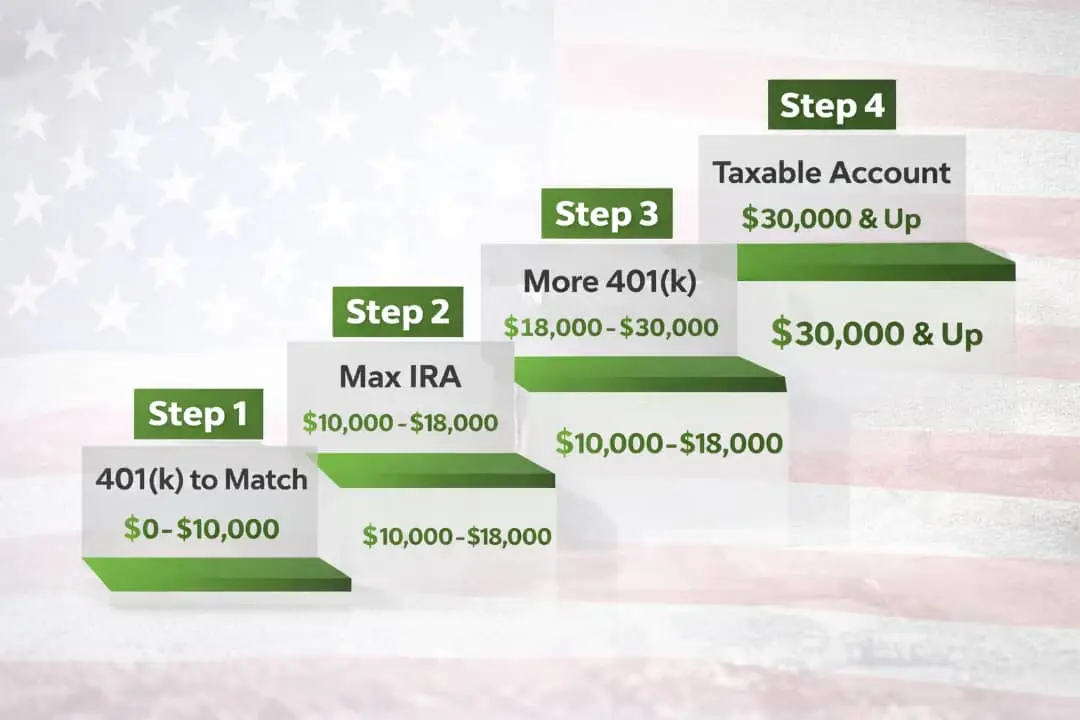
Step 1: Contribute to your 401(k) up to the employer match.
If your employer matches 50% of your contributions up to 6% of your salary, contribute at least 6%. Anything less is refusing free money.
Step 2: Max out your IRA.
Once you’ve captured the full match, redirect savings to an IRA. Contribute the full $7,000 (or $8,000 if 50+) to either a Traditional or Roth IRA, depending on your tax situation.
Step 3: Return to your 401(k).
After maxing your IRA, go back to your 401(k) and contribute additional money up to the annual limit. This maximizes your tax-advantaged space.
Step 4: Use a taxable brokerage account.
If you still have money to invest after maxing both accounts, a regular taxable brokerage account is your next stop.
REAL NUMBERS EXAMPLE
Let’s say you’re 40 years old, earning $80,000 annually, and can save 15% of your income ($12,000 per year):
Option A: 401(k) Only
- Contribute $12,000 to 401(k)
- Get full employer match (say 50% up to 6% = $2,400 free money)
- Total annual contribution: $14,400
- Investment choices: Limited plan menu
Option B: Both Accounts
- Contribute 6% to 401(k) = $4,800 + $2,400 match = $7,200
- Max IRA = $7,000
- Total annual contribution: $14,200 (nearly identical)
- Investment choices: Best of both worlds match PLUS unlimited IRA options
The “both” approach gives you the match AND investment flexibility for essentially the same total contribution.
FINAL THOUGHT
The 401(k) vs. IRA debate is a false choice.
Your 401(k) gives you free money (the match) and high contribution limits.
Your IRA gives you investment freedom and lower fees.
They’re not competitors. They’re teammates. Use them together, in the right order, and you’ll build retirement wealth faster than choosing one over the other.
READY TO OPTIMIZE YOUR RETIREMENT ACCOUNTS?
VISIT wealthintelreport.com for our free Retirement Account Optimization Guide. We’ll show you exactly how to prioritize your contributions based on your income, age, and goals designed specifically for U.S. investors.
FOLLOW @wealthintel on TikTok for daily wealth-building content that actually moves the needle for building real wealth.
DISCLAIMER
This content is for educational purposes only and not financial advice. Contribution limits and tax rules are based on current U.S. law and subject to change. Individual circumstances and employer match formulas vary. Consult a qualified tax professional before making retirement decisions. wealthintelreport.com and @wealthintel assume no liability.