


INTRODUCTION
Walk into any insurance agent’s office and you’ll hear a compelling story:
“Wouldn’t you rather have protection THAT ALSO builds savings? Why pay for insurance you might never use when you can get your money back AND leave something to your family?”
It sounds perfect. Protection plus savings. The best of both worlds.
But here’s what agents don’t emphasize:
That “savings” component comes at an enormous cost—one that leaves most families worse off than if they’d simply bought term insurance and invested the difference themselves.
Life insurance is a tool. Like any tool, it works brilliantly for specific jobs and terribly for others. The key is knowing which tool fits your actual needs.
Let’s break down exactly how term and whole life work, why one is usually the better choice, and who actually needs the other.
WHAT IS TERM LIFE INSURANCE?
Term life is pure protection. Nothing else.
You choose a specific period—10, 15, 20, or 30 years. You pay a fixed premium each month. If you die during that term, your beneficiaries receive the death benefit, tax-free.
If you outlive the term, coverage ends. That’s it. No payout. No cash returned. No savings. Just years of protection that you no longer need because the people depending on your income are now self-sufficient.
Term life is simple. The premiums are predictable. The contracts are straightforward. You know exactly what you’re buying and exactly what it costs.
A healthy 35-year-old might pay $30-$50 monthly for $500,000 in coverage over 20 years. That’s roughly $10,000 total over two decades for half a million dollars of protection.
WHAT IS WHOLE LIFE INSURANCE?
Whole life is protection PLUS a savings account wrapped together.
You pay premiums for your entire life—hence the name. Part of that premium covers the insurance cost. The rest goes into a “cash value” account that grows over time, tax-deferred.
That cash value is yours. You can borrow against it. You can surrender the policy and take the cash. In some cases, you can use it to pay premiums later.
Sounds good, right?
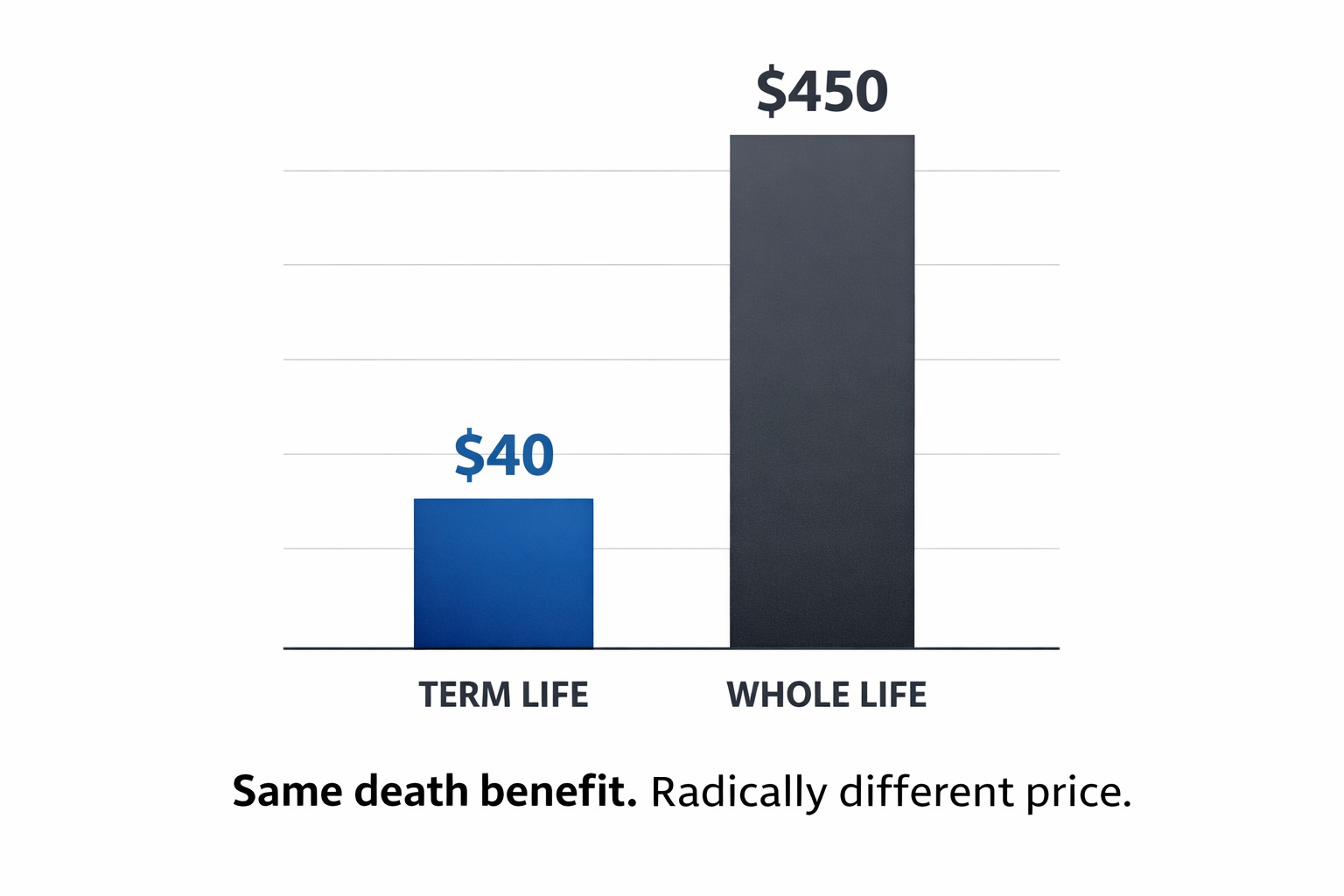
Here’s the catch: whole life premiums are dramatically higher than term. That same 35-year-old might pay $400-$500 monthly for $500,000 in whole life coverage. Ten times the cost for the same death benefit.
And that cash value? It typically grows at 2-4% annually—far less than you’d earn in a simple index fund.
8 KEY DIFFERENCES BETWEEN TERM AND WHOLE LIFE
1. COST DIFFERENCE
Term Life: A 35-year-old non-smoker in good health can get a 20-year, $500,000 term policy for $30-$50 per month. Total cost over 20 years: roughly $10,000. For half a million dollars of protection.
Whole Life: Same person, same death benefit: $400-$500 per month. That’s $100,000+ over 20 years. For the SAME death benefit. The difference is the cash value component—which you’re paying dearly to build.

2. INVESTMENT RETURNS
Term Life: Zero investment component. You’re buying pure protection. The money you save on premiums can be invested elsewhere in index funds, retirement accounts, or real estate.
Whole Life: The cash value grows at 2-4% typically. Some policies pay dividends that can boost returns slightly. But compare that to the S&P 500’s historical average of 10% annually. Over 30 years, that difference is enormous.
3. COMMISSIONS AND CONFLICTS
Term Life: Agents earn modest commissions—often 10-30% of your first year’s premium. A $500 term policy pays them $50-$150. They’re not getting rich selling terms
Whole Life: First-year commissions often reach 50-100% of your premium. That $5,000 whole life premium pays the agent $2,500-$5,000 upfront. Follow the money. Agents push what pays them best, not what serves you best.
4. FLEXIBILITY
Term Life: You choose a term that matches your need. Kids grown? Mortgage paid? Coverage ends. You’re not paying for protection you no longer require.
Whole Life: You’re committed for life, literally. Stop paying and you lose coverage AND potentially surrender charges on your cash value. It’s much harder to change course.
5. CASH VALUE ACCESS
Term Life: No cash value. No borrowing. Just death benefit protection. Simplicity has trade-offs.
Whole Life: You can borrow against the cash value. But here’s the trap: borrow and die with the loan outstanding. The death benefit is reduced. And loans charge interest—to YOU, from YOUR policy.
6. DEATH BENEFIT CERTAINTY
Term Life: If you die during the term, beneficiaries get the full death benefit. If you outlive it, nothing. That’s the gamble you accept.
Whole Life: Death benefit is guaranteed as long as premiums are paid. You will die someday, so the policy WILL pay out. That certainty has value but at a massive cost.
7. THE “BUY TERM AND INVEST THE DIFFERENCE” MATH
Let’s run the numbers:
Whole Life Path:
- Pay $500/month for 30 years = $180,000 total
- Cash value after 30 years: roughly $100,000-$120,000 (at 3% growth)
- Death benefit: $500,000 (reduced by any loans)
Term + Invest Path:
- Pay $50/month for 20-year term policy = $12,000 total
- Invest $450/month in S&P 500 index fund for 30 years
- At 8% average return: roughly $620,000 in cash
- Plus, term coverage during the years it mattered
You end up with MORE cash AND have protection when you need it.
8. WHO ACTUALLY NEEDS WHOLE LIFE
There is a tiny slice of the population whose whole life makes sense:
- You’ve already maxed all tax-advantaged accounts (401k, IRA, HSA)
- You have ultra-high net worth ($5M+) and need estate planning tools
- You want to pass money to heirs with favorable tax treatment
- You have a special needs dependent requiring lifetime care
For roughly 99% of people? Term life + investing the difference wins every time.
THE IDEAL STRATEGY: HOW MOST PEOPLE SHOULD USE LIFE INSURANCE
Step 1: Calculate your need.
How many years until your kids are independent? Until your mortgage is paid? Until your spouse can support themselves? That’s your term length. Multiply your annual income by 10-12X. That’s your coverage amount.
Step 2: Buy term life.
Shop rates at multiple companies. Level premiums for the full term. No bells. No whistles. Just pure protection.
Step 3: Invest the difference.
Open a low-cost brokerage account or max your retirement accounts. Put the money you saved on premiums into broad market index funds (VOO, VTI, IVV). Set automatic investments. Watch it grow.
Step 4: Reassess every 5-10 years.
As your savings grow, your need for insurance drops. You’re self-insuring more of your risk. Eventually, you may not need life insurance at all.
REAL NUMBERS EXAMPLE
Meet Sarah, age 35, needs $500,000 coverage:
Term Life:
- Monthly premium: $45
- Cost over 20 years: $10,800
- Invests $405 monthly difference
- At 65: $450,000+ in investments
- Insurance need gone (kids grown, mortgage paid)
Whole Life:
- Monthly premium: $450
- Cost over 20 years: $108,000
- Cash value at 65: $80,000-$90,000
- Still paying premiums forever
- Death benefit still $500,000
Sarah with term + invest has over $450,000 CASH and owes nothing. Sarah with whole life has $80,000 in cash value and must keep paying to maintain coverage.
FINAL THOUGHT
Whole life insurance is a masterfully marketed product.
It promises what sounds like common sense: why rent protection when you can own something that builds value?
But the math doesn’t lie. The returns are mediocre. The costs are enormous. The complexity hides the truth.
Term life is boring. It’s simple. It doesn’t make salespeople rich.
But boring, simple, and cheap is exactly what protection should be.
Buy term. Invest the difference. Build real wealth.
READY TO BUILD YOUR TERM + INVEST STRATEGY?
VISIT wealthintelreport.com for our free Term Life Calculator and Investment Difference Guide. We’ll show you exactly how much you could accumulate by choosing simple protection and investing the savings.
FOLLOW @wealth Intel on TikTok for daily money truth bombs that actually build wealth.
DISCLAIMER
This content is for educational purposes only and not financial or insurance advice. Life insurance needs vary based on individual circumstances; term and whole life policies have different features and limitations. Consult a qualified professional before purchasing any insurance product. wealthintelreport.com and @wealth Intel are not licensed insurance agents and assume no liability.